Best Help Authoring Tools (HAT)

Adam Crivello
AC
Researched and written by Adam Crivello

Help Authoring Tools (HAT) are programs designed to assist technical writers in designing, publishing, and maintaining software help documentation. The resulting text is used in explanation guides, manuals, and help files. They are aimed at reducing time and effort needed when creating assistance materials for employees and end users. Technical writers will use help authoring tools to create documents from start to finish. With the programs, they are able to write, edit, and export the documents to then be shared with editors, administrators, and other co-workers. Eventually, the help authoring tool will allow writers to publish the documentation digitally. Many of these products will import text in different file formats or document creation software. Some products which do not posess build tools will need to intergate with build automation tools to be viewed or used.

To qualify for inclusion in the Help Authoring Tools (HAT) category, a product must:

Possess tools for editing text, data, or code
Provide an input for source text
Provide an output for help files
Possess tools for adding indexes, content tables, or images
Provide tools for interface customization
Show More
Show Less

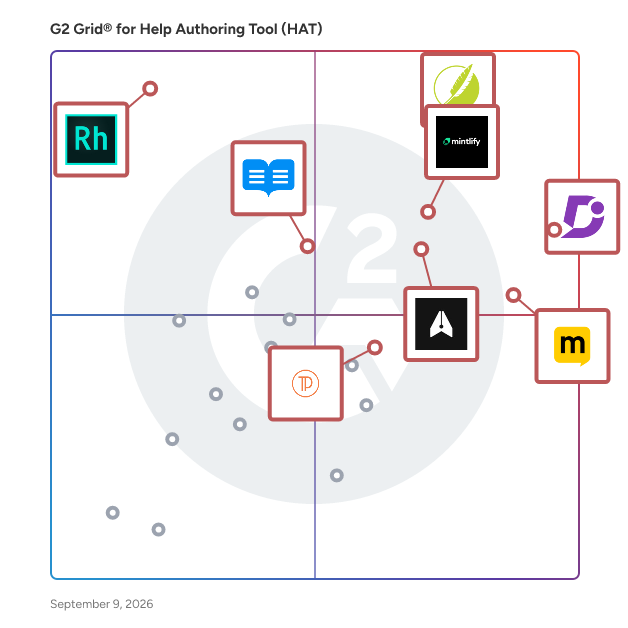
Featured Help Authoring Tools (HAT) At A Glance

Highest Performer:
Easiest to Use:
Top Trending:
Show LessShow More
Highest Performer:
Easiest to Use:
Top Trending:

G2 takes pride in showing unbiased reviews on user satisfaction in our ratings and reports. We do not allow paid placements in any of our ratings, rankings, or reports. Learn about our scoring methodologies.

No filters applied
54 Listings in Help Authoring Tool (HAT) Available
(498)4.7 out of 5
Entry Level Price:Contact Us
1st Easiest To Use in Help Authoring Tool (HAT) software
(486)4.4 out of 5
Entry Level Price:Contact Us
8th Easiest To Use in Help Authoring Tool (HAT) software
View top Consulting Services for MadCap Flare
G2 Advertising
Sponsored
G2 Advertising
Get 2x conversion than Google Ads with G2 Advertising!
G2 Advertising places your product in premium positions on high-traffic pages and on targeted competitor pages to reach buyers at key comparison moments.
(64)4.8 out of 5
Entry Level Price:$185.00
7th Easiest To Use in Help Authoring Tool (HAT) software
(44)4.5 out of 5
Entry Level Price:Free
6th Easiest To Use in Help Authoring Tool (HAT) software
(118)4.6 out of 5
2nd Easiest To Use in Help Authoring Tool (HAT) software
(22)4.8 out of 5
Entry Level Price:$1099
5th Easiest To Use in Help Authoring Tool (HAT) software
(16)4.8 out of 5
Entry Level Price:$199.00
3rd Easiest To Use in Help Authoring Tool (HAT) software

Learn More About Help Authoring Tools (HAT)

What are Help Authoring Tools (HAT)?

Help authoring tools (HAT) are programs designed to assist technical writers in designing, publishing, and maintaining software help documentation. The resulting text is used in explanation guides, FAQs, manuals, and help files. They are aimed at reducing the time and effort needed when creating assistance materials for both employees and end users. Many help authoring tools (HAT) also provide the functionalities of knowledge base software, which allows technical writers to maintain and update a central knowledge base containing all software help text that they created about their product. This knowledge base, which is often a user-accessible web page or document, can be updated as soon as technical writers add new text or images. Despite being used by specialized technical writers, HATs are often considered development tools since they allow development teams to create and maintain help documentation for their existing software products and any new features that might be added.

Technical writers use help authoring tools to create software help documents and online help resources from start to finish. With these programs, they can write, edit, and export documents to be shared with editors, administrators, and other coworkers. Depending on the documentation tool used, creators can even design images or simply use a screen capture feature to supplement their software help text and enrich the user experience. When the documentation is in a user-ready state, the help authoring tool allows writers to publish the documentation digitally. In some cases, HATs also allow teams to manage other aspects of their customers’ self-help experiences. For example, some tools allow product teams to create and embed widgets at various points in the user journey, guiding the user towards a software help knowledge base if needed.

Most HATs allow technical writers to centralize their software help documentation in a single database, which can then be exported in various formats such as HTML, CHM help files, XML, PDFs, and more. Help authoring software also allows technical writers to use and update their pre-existing software program documentation by supporting various file types for import. This also provides flexibility for writers who prefer to use a separate writing tool outside of the HAT, as they can simply import the source text when it’s complete and use the HAT to design, publish, and maintain the finished product.

Ultimately, HATs help companies produce, add to, and manage a single source of truth for their users’ software help needs. By streamlining the writing process and providing useful features like content collaboration and file importing, HATs help teams produce technical documentation, content for faqs, help manuals, and more.

What Does HAT Stand For?

HAT stands for Help Authoring Tool. However, HATs can extend beyond documentation authoring to allow teams to manage various aspects of their customers’ software program self-help experiences. 

What are the Common Features of Help Authoring Tools (HAT)?

The following are some core features within help authoring tools (HAT) that can help users create and maintain software help documentation:

Text editing: At their most basic, HATs provide text-editing functionality to create software help documentation. These editors will often include several features to make the help authoring process more efficient, such as templates, automated style and grammar suggestions, and more. In many cases, a HAT’s user interface will act as a full-fledged word processor.

Code editing: Many HATs include a code view that allows front-end web developers to manipulate help documentation webpages. This type of editing usually includes HTML, CSS, and JS code editing capabilities so that technical writers can create software documentation that lives in a web-based format as opposed to a text document. Some solutions also include features for HTML help and suggestions, allowing teams to build web pages more easily.

WYSIWYG editing: Many HATs provide WYSIWYG (what you see is what you get) editors, so technical writers without experience in front-end development can author and manage software documentation web pages via an intuitive visual user interface. These types of editors can also be helpful for quickly adding useful images to a product’s help documentation.

File importing: HATs allow technical writers to import source text or source code from various file formats, such as Microsoft Word documents, CHM files, HTML files, and more. The text and images from these source files can then be manipulated and managed within the HAT to produce the desired result for publication.

Content management: While HATs are used explicitly to author and manage software help documentation, they typically share similar features with content management systems (CMS). Like CMS tools, HATs allow users to manage, store, and track content projects from creation to publication. The key difference is that each content project is specifically related to software explanation guides, faqs, manuals, and help files.

Templates and libraries: Most HATs provide templates that provide base-level formatting and visual layouts for technical writers to work off of. These templates provide suggested layouts for various software help formats. Along with these templates, many HATs offer media libraries for authors to pull images, motion graphics, and more.

Content collaboration: Help authoring software allows multiple technical writers to work on the same guides and documents concurrently. This streamlines communication about projects and enables efficient productivity in a remote environment. HATs’ content collaboration capabilities include version control systems; meaning teams can keep track of historical changes and revert to older versions of their documentation when necessary.

What are the Benefits of Help Authoring Tools (HAT)?

The common benefits of help authoring tools (HAT) include:

Scalability: Software providers must supplement their products with a lot of documentation to guide their users. From simple user guides to complex technical documentation for APIs, user knowledge management must be constantly considered and supported as a company adds to its product lines and features. HATs make this process scalable and manageable by both importing existing documentation and providing standardized tools for adding to that documentation. 

Efficiency: Most HATs centralize all of a company’s technical documentation, online help content, etc., to a single source. By storing all software help source files in a central database, HATs facilitate more efficient content reuse. Technical writers can manage, edit, and add to their existing documentation once, then use the HAT to choose where, when, and how that documentation is presented. In some cases, teams can even set conditional publishing standards so that different help documentation is shown to different users. This prevents teams from wasting time with repeated tasks, allowing them to focus on new documentation rather than manually managing existing content. 

Better customer support: HATs primarily boost a company’s ability to provide helpful documentation to its customers. By curating user-friendly documentation with clear elements like a table of contents, visual aids, and more, companies empower their users to self help rather than rely on customer support channels. Having thorough self-help systems in place saves companies time and mitigates costs related to supporting their customers.

Who Uses Help Authoring Tools (HAT)?

Technical writers: Technical writers produce documentation to facilitate clear and thorough communication between two parties. They use HATs to create user manuals, tutorials, and other software help documentation for the benefit of their company’s employees and customers. 

Developers: Developers can use HATs to add helpful documentation to their consumer-facing software. A common use case for developers using HATs is API documentation, which guides other developers on how to properly interface with their API. Front-end developers building software help web pages can also utilize HATs and take advantage of their HTML help suggestions to tackle issues and solve problems with their design.

Software Related to Help Authoring Tools (HAT)

Related solutions that can be used together with help authoring tools (HAT) include:

Knowledge base software: Knowledge base software stores and organizes information about businesses and their products, services, and processes in a central repository accessible by the rest of the organization. Businesses use knowledge bases to bring information from different sources, such as internal communications platforms or email software, into a self-serve digital library that acts as a single source of truth. HATs often interact with and add to a company’s help documentation stored in a central knowledge base.

Enterprise content management (ECM) systems: Enterprise content management (ECM) systems help companies organize, manage, and distribute unstructured content such as documents, images, health or accounting records, surveys, product information, emails, and web pages. Companies use this software to store, track, edit, and collaborate on content creation and other information-related projects. In many ways, HATs are a more narrow version of a content management system.

Challenges with Help Authoring Tools (HAT)

Software solutions can come with their own set of challenges. 

File support: Companies onboarding a new HAT must be mindful of the tool’s supported file types. If the tool can’t seamlessly import a company’s existing help documentation, then the company is faced with the frustrating task of repeating work. Given that technical help documentation is often formatted with specific layouts in mind, especially when dealing with web pages, the process of recreating that formatting can be particularly tedious. Buyers should be mindful of which file types a prospective HAT supports, such as CHM help files, HTML files, Markdown files, and more.

Standardization: One key element companies should strive to achieve when authoring help documentation is standardization. Employees and customers engaging with a company’s self-help systems should experience a consistent user journey to avoid confusion. A good HAT will help teams produce consistent technical writing via templates and customizable writing guidelines. 

Learning curve: Using a new HAT can come with a learning curve, especially for newer employees in technical writing. Choosing a HAT with a smooth learning curve is important so that the efficiency gained by using the tool isn’t canceled out by the effort involved in learning it. 

How to Buy Help Authoring Tools (HAT)

Requirements Gathering (RFI/RFP) for Help Authoring Tools (HAT)

G2.com can assist buyers in finding the best help authoring tool (HAT), whether a buyer is searching for HATs for the first time or looking to replace legacy software.

Generally, the most important considerations are price, feature set, and file support. One of the primary purposes of HATs is to make software documentation management more convenient, so ensuring that the tool of choice can seamlessly import the company’s existing documentation is often essential. Using G2 reviews as a reference, buyers can determine the features that will best help them manage their software help documentation, ensuring a pain-free learning curve and comprehensive solution. 

After narrowing down a potential pool of products, teams can then apply further considerations for budget, requirements, and more. Using this approach, buyers can move forward in the buying process with confidence, referencing their checklist in conjunction with G2 scores to find the right solution for their needs.

Compare Help Authoring Tools (HAT) Products

Create a long list

Buyers should consider the many HAT solutions on the market. Some HATs include WYSIWYG functionality to provide technical writers with a non-developer solution to publishing web pages, while others shine in the hands of users proficient in HTML, CSS, and JavaScript. Buyers should consider options like these to produce a long list of potentially viable products.

Create a short list

Once a long list is created, buyers should employ a more granular approach to trim it down. Along with a matrix of must-have functionality and pricing, buyers can use G2 reviews to explore any potential advantages and disadvantages among the products they’re considering. With these factors in mind, buyers should narrow down their search to a list of three to five products.

Conduct demos

All software products on a company’s short list need to be investigated firsthand via demos to ensure that real-time functionality matches on-paper expectations. During demos, buyers should make inquiries based on the requirements gathering they’ve done prior; for example, one might ask to be walked through a HAT’s collaborative content management features to ensure the company’s needs will be met. 

Selection of Help Authoring Tools (HAT)

Choose a selection team

Companies of any size should try to involve the most relevant personas when beginning the HAT selection process. Large companies might have the resources to include individual team members to fill roles such as project manager, decision maker, and technical writer. Smaller companies can overlap roles to compensate for their relatively fewer employees. 

Negotiation

Some vendors offer HATs that can do far more than what the buyer requires, such as full-featured web design. While some vendors may only offer an all-or-nothing package, buyers who want to optimize spending should try to negotiate a fairly priced package, including only the functionalities that matter to them. For example, a product’s pricing page could show that the buyer’s must-have features are only included with an expensive all-in-one package, whereas a sales conversation may prove otherwise. 

Final decision

To conclude the process, performing a trial run with a small pool of technical writers or developers is essential. This will aid buyers in ensuring that their chosen HAT is easy to use, integrates well with existing workflows, and meets team members’ needs. If the HAT is received well and utilized often, the buyer’s selection is probably the right one. If not, it may be time to try another product from the short list.