How to Buy Location-Based Marketing Software
Requirements Gathering (RFI/RFP) for Location-Based Marketing Software
Location-based marketing software helps businesses gain visibility in their specific locations. Searching for software based on the marketing automation stage can help purchase the most suitable location-based marketing software.
Compare Location-Based Marketing Software Products
Create a long list
Making a list of all the vendors selling location-based marketing software can give businesses a direction to look for potential vendors in the market. This list depends on the software's features and pricing plans.
Create a short list
After going through the long list, vendors that fulfill the buyer’s requirements are shortlisted. Vendors that satisfy the company’s feature requirements and fall under their budget requirements are chosen at this stage.
Conduct demos
While selecting a suitable location-based marketing vendor, it is advisable to have vendors conduct demos. This allows the buyers to understand the features and benefits of using the product from the specific vendor. Usually, business users, decision makers, and IT professionals are involved in this stage.
Selection of Location-Based Software
Choose a selection team
The selection team consists of business users who can also be decision makers in some organizations, such as the chief marketing officer and an IT professional who can help install the software.
Negotiation
After shortlisting specific vendors, negotiations occur based on the buyers' required features and the software's pricing plans. This also depends on the end use of the software. Depending on that, certain customizations can also be requested.
Final decision
After settling on the vendor, the decision makers make the final choice after discussions with other team members.
Location-Based Marketing Software FAQs
Most Popular FAQs
Which location-based marketing software has the best reviews?
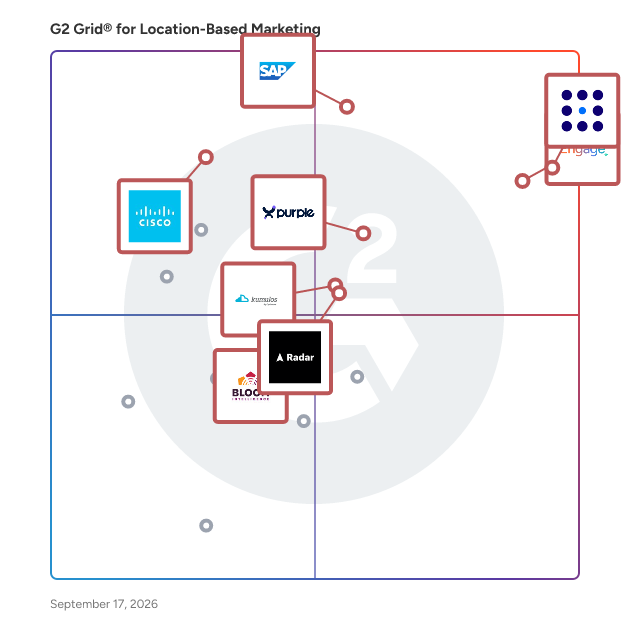
Across G2's location-based marketing category, these platforms pair strong satisfaction scores with the largest review bases:
-
SingleInterface : 4.7 stars across 101 reviews, with reviewers citing a smooth platform experience and responsive, supportive coordination.
-
Flame Analytics : 4.6 stars across 81 reviews, positioned per the vendor as location analytics and engagement for physical spaces.
-
SAP Engagement Cloud : 4.3 stars across 640 reviews, used per its category-tagged reviewers for campaign building with real-time insights.
-
Netmera : 4.3 stars across 49 reviews, valued for fast segmentation and campaign setup, with banking enterprises among its reviewers.
Two honesty notes: Paige at 4.8 on 36 reviews and Optimove at 4.8 on 30 hold the category's highest scores on its smallest bases, and SAP Engagement Cloud spans many G2 categories, so read the reviews tagged to location-based marketing specifically. Review volume across this category is modest overall, which makes reading individual reviews more useful here than in larger categories.
What are examples of location-based marketing in practice?
The clearest examples in this year's reviews and vendor documentation span WiFi capture, segmented push, campaign triggers, and local presence.
-
Purple: Venues offer guest WiFi through a branded portal, capture first-party contact data at login, and feed it into automated campaigns, per the vendor, with footfall analytics on movement and return visits.
-
Netmera: Banks and fintechs send segmented push notifications, with geofencing among the channels listed per the vendor, and reviewers confirm building targeted audiences without technical support.
-
SAP Engagement Cloud: Enterprise retail reviewers trigger product-centric campaigns from real-time customer signals.
-
SingleInterface: Multi-location brands manage local presence across Search and Maps so nearby customers find accurate store information.
Every example shares one dependency the Challenges section describes: The customer has to opt in, whether at a WiFi portal, an app permission prompt, or a subscription.
Which vendor provides the most accurate foot traffic data?
On the most accurate foot traffic data, G2 reviews from the past year do not crown one vendor, and that is the honest answer worth having before a vendor conversation:
-
Flame Analytics: Positioned on foot traffic measurement, with accuracy described per vendor documentation.
-
Purple: Also positioned on foot traffic measurement per vendor documentation, with limited fresh reviews confirming good access to performance data rather than auditing its precision.
-
Placer.ai: Often shortlisted by buyers comparing beyond this category, with visitation measurement and trade-area claims likewise vendor-stated, carrying a 4.3 rating on just 10 G2 reviews under location intelligence.
-
Netmera: Supplies the most instructive accuracy evidence from an adjacent product, with banking analysts flagging metric combinations that fail basic logic checks, like opens recorded against zero sends, showing why platform-reported numbers deserve verification regardless of vendor.
Two accuracy limiters apply to everyone, since VPNs misreport location and users who decline permissions are invisible: Compare platform visitor numbers against door counters, POS transactions, or an internal source for 30 days before relying on them.
How does location-based marketing handle privacy and consent?
Consent comes first, then the campaign; every mechanism in this category runs on permission. The compliance feature set covers GDPR and CCPA standards for personal data collection, and Netmera lists GDPR, ISO certifications, and market-specific coverage like IYS per the vendor, with banking enterprises among its active reviewers. The most transparent consent model in the category is the WiFi exchange: Purple venues offer guest WiFi and collect first-party data at a branded login where the customer sees the trade, per the vendor. App-based approaches depend on permission prompts, and as this guide's Challenges section notes, permission rights stay with users, so campaigns only ever reach the opted-in share of an audience. For buyers in stricter markets, the practical checks are vendor certifications per region, consent-record storage, and how easily a customer's data can be deleted on request. This question reflects a dominant pattern across search results for this category rather than a single source.
Which location-based marketing platforms serve retail properties measuring event-driven foot traffic?
For retail property teams that want event-driven foot traffic and visitor lift measured, the honest state of the evidence matters here, and the best platforms built closest to that use are largely vendor-documented this year:
-
Flame Analytics: Positions itself, per the vendor, as a location analytics and engagement platform for physical spaces, holding a 4.6 rating on 81 reviews, though no fresh reviews surfaced in the past year's window.
-
Purple: Describes, per the vendor, WiFi presence and footfall analytics showing how guests move, dwell, and return across more than 80,000 venues including retail, stadiums, and public spaces; its limited fresh reviews in the past year value the access to performance data and strong support, while noting the experience benefited from dedicated staff on both sides.
-
Placer.ai: The tool built most directly for this question, sitting just outside this category, positions its foot-traffic data, per the vendor, around measuring visitation, benchmarking competitors, and finding and winning the ideal tenant or property for retail and commercial real estate teams; it is listed on G2 under location intelligence with a 4.3 rating on a small base of 10 reviews.
For a property team, that evidence shape suggests a specific ask: Request a live dashboard from a comparable venue and a reference call with a property running event measurement today, before weighting either vendor's lift claims.
Which location-based marketing tools connect foot traffic data to sales and conversion?
Store visits count as a benefit only when they show up in sales, and reviews from the past year show where that foot traffic to sales and conversion connection is strongest:
-
SingleInterface: Reviewers describe a smooth platform experience with responsive coordination support, and the vendor positions it around turning Search, Maps, and AI discovery into store visits for multi-location brands.
-
Purple: Connects, per the vendor, WiFi presence data to first-party profiles and automated campaigns, and its limited fresh reviews confirm usable access to performance data.
-
SAP Engagement Cloud: On the campaign side, enterprise retail reviewers build product-centric campaigns with real-time insights flowing between SAP and non-SAP systems.
The gap reviewers name sits at the last step, where some Paige agency reviewers wish the platform tracked campaign ROI for ad spend, a reminder that connecting activity to conversion is where this category's tools thin out: Ask every vendor to demo the exact join between one campaign and one store-level sales or conversion metric using your data, not sample data.
What is the highest rated location-based marketing software for retail events ROI?
Retail is the segment where ratings and ROI claims, meaning visitor lift and sales attribution for events, get tested together, and the honest reading separates them:
-
SingleInterface: Leads on ratings with meaningful bases at 4.7 stars across 101 reviews.
-
Flame Analytics: Holds 4.6 across 81, though its fresh review activity was quiet this year.
-
SAP Engagement Cloud: The closest reviewer evidence on the ROI side, with enterprise retail reviewers gathering real-time campaign insights across connected systems.
-
Zeta Marketing Platform: Retail reviews value having all performance metrics in one place, while noting a second login for the detailed analytics layer.
No reviewer in the past year's window documents a completed event-level attribution study, so treat rating and attribution capability as two separate checks: Before contracting for event ROI, pilot one event with the lift math agreed in advance, meaning the comparison window, the control group, and who counts the visits.
Small Business FAQs
What is the most affordable location-based marketing software for small businesses?
Pricing is rarely public in this category, so the useful signals come from reviewers across the small business location-based marketing segment.
-
Paige: Small business reviews call the price very reasonable for the feature set, and value that a solo operator can serve more clients with it; the cost note comes from multi-location users paying per profile, who ask for tiered pricing because roughly $100 per location adds up quickly.
-
Netmera: Reviewers highlight starting without a long onboarding process, which keeps early costs down.
The general rule from this category's reviews: Per-location and per-profile pricing structures decide affordability faster than the base subscription does, so count your locations before comparing plans.
Which location-based marketing software is the most user-friendly?
Paige, Netmera, and SingleInterface draw the strongest ease-of-use reviews in the past year.
-
Paige: Reviewers describe setup in minutes, with reviews describing it as follow along, read, and click; agency users onboard clients quickly with automated posting running in the background.
-
Netmera: Users call the interface simple enough to work intuitively, with campaigns and segments built without technical support.
-
SingleInterface: Reviewers describe the overall experience as smooth.
The contrast cases are specific, with Croct reviewers noting some tests still require developer knowledge and miss a visual editor, and Netmera reviews finding in-app survey and widget building more manual than expected: If your team has no developer time, weight the first group.
Which location-based marketing software works best for small local businesses?
Paige has the most small-local-business review evidence in the category this year: Reviewers use it to keep Google Business Profiles active, respond to reviews automatically, generate localized posts with AI, and track map-ranking improvement over 30-day to 12-month windows, with several agency owners building client services on it. Its reviewers supply the working caveats too: The optimization score penalizes channels a business simply does not use, like YouTube, and some agency reviewers note results slow when the business owner is not consistent. For a local business whose location marketing is mostly about being found nearby rather than triggering proximity campaigns, this local-presence approach may cover the need before geofencing tools enter the picture.
Enterprise FAQs
What is the best-rated location-based marketing software for enterprises?
Enterprise reviewers wrote 41 of the 134 reviews G2 collected across leading products in this category in the past year, so a pilot will tell you more than a rating at this segment. Within that base, the most substantive enterprise evidence sits with Netmera and SAP Engagement Cloud.
-
Netmera: Banking reviewers confirm the data meets bank requirements and value SFTP access, though analysts flag occasional metric inconsistencies worth verifying.
-
SAP Engagement Cloud: Enterprise retail reviews describe running campaign programs across connected SAP and non-SAP systems with support they rate highly, while reviewers ask for more flexible targeting across multiple segments.
Zeta Marketing Platform also serves enterprise marketers, with its category-tagged reviews citing consolidated metrics alongside a double-login annoyance for the deeper analytics layer.
What should enterprises evaluate in location-based marketing solutions?
Based on recent G2 reviews, enterprises should evaluate the following in location-based marketing solutions:
-
Data consistency: Netmera banking reviewers flag metrics that fail logic checks and FTP transfers that break pipelines, so test exports against an internal source.
- Compliance coverage: Certifications like GDPR, ISO, and market-specific programs are vendor-stated, so verify the exact certificates for each market you operate in.
-
Developer dependence: Croct reviewers note some work still requires developer knowledge, a staffing question before rollout.
-
Reporting depth: Netmera users ask for more detailed campaign analytics, and Zeta Marketing Platform reviews flag a separate login for the detailed data layer.
-
Support model: Purple reviews credit dedicated staff on both sides for the strong experience, so confirm what support tier your contract actually includes.
Rank these by your exposure, and pilot with your own venues and data before committing across locations.
Can location-based marketing solutions deliver accurate visitor metrics for regulated industries?
Yes, with verification built in, and the category's location data challenges explain why regulated buyers ask for accurate visitor metrics in writing. The strongest regulated-industry evidence in the past year comes from banking: Enterprise reviewers at banks run Netmera for segmentation and campaign data, with reviews confirming the data fully meets bank requirements and praising SFTP-based access. The same review base supplies the accuracy caveat that makes this question worth asking: Banking analysts flag metric inconsistencies, such as notifications recorded as opened when the send count reads zero, plus FTP transfers that occasionally break data pipelines. On compliance, Netmera lists GDPR, ISO certifications, and IYS coverage per the vendor, and Purple names healthcare among its venue types, per the vendor. For a regulated deployment, the reviewer-tested practice is the right one: Run a 30-day parallel count between the platform's visitor metrics and an internal source before any lift number reaches a compliance-sensitive report.