# Best Enterprise Customer Data Platforms (CDP) - Page 2

  *By [Alanna Iwuh](https://research.g2.com/insights/author/alanna-iwuh)*

   Products classified in the overall Customer Data Platform (CDP) category are similar in many regards and help companies of all sizes solve their business problems. However, enterprise business features, pricing, setup, and installation differ from businesses of other sizes, which is why we match buyers to the right Enterprise Business Customer Data Platform (CDP) to fit their needs. Compare product ratings based on reviews from enterprise users or connect with one of G2&#39;s buying advisors to find the right solutions within the Enterprise Business Customer Data Platform (CDP) category.

In addition to qualifying for inclusion in the Customer Data Platforms (CDP) category, to qualify for inclusion in the Enterprise Business Customer Data Platforms (CDP) category, a product must have at least 10 reviews left by a reviewer from an enterprise business.


  ## How Many Customer Data Platforms (CDP) Products Does G2 Track?
**Total Products under this Category:** 289

  
## How Does G2 Rank Customer Data Platforms (CDP) Products?

**Why You Can Trust G2's Software Rankings:**

- 30 Analysts and Data Experts
- 23,700+ Authentic Reviews
- 289+ Products
- Unbiased Rankings

G2's software rankings are built on verified user reviews, rigorous moderation, and a consistent research methodology maintained by a team of analysts and data experts. Each product is measured using the same transparent criteria, with no paid placement or vendor influence. While reviews reflect real user experiences, which can be subjective, they offer valuable insight into how software performs in the hands of professionals. Together, these inputs power the G2 Score, a standardized way to compare tools within every category.


---

**Sponsored**

### Contentful

Contentful is a digital experience platform (DXP) designed for marketers, developers, and digital teams who need to build, personalize, and deliver impactful experiences across every channel—quickly and at scale. By combining its headless CMS with native, contextual AI, Contentful enables rapid creation, seamless management, and consistent omnichannel delivery of on-brand, data-driven content. Contentful empowers teams to adapt, reuse, personalize, and publish modular content and design components without reliance on developers, enabling rapid iteration and real-time targeting, experimentation, and optimization at the component level. Complemented by a robust ecosystem, and built on an infinitely-extensible, API-first platform, Contentful gives teams the freedom to easily build or deploy new experiences and integrations quickly to meet the ever-evolving needs of their brand. Trusted by global market leaders, Contentful is engineered for enterprise reliability, extensibility, and future-proof growth—helping organizations maximize ROI and outperform in today’s competitive digital landscape.


[Visit website](https://www.g2.com/external_clickthroughs/record?secure%5Bad_program%5D=ppc&amp;secure%5Bad_slot%5D=category_product_list&amp;secure%5Bcategory_id%5D=1202&amp;secure%5Bdisplayable_resource_id%5D=1414&amp;secure%5Bdisplayable_resource_type%5D=Category&amp;secure%5Bmedium%5D=sponsored&amp;secure%5Bplacement_reason%5D=neighbor_category&amp;secure%5Bplacement_resource_ids%5D%5B%5D=1674&amp;secure%5Bprioritized%5D=false&amp;secure%5Bproduct_id%5D=4941&amp;secure%5Bresource_id%5D=1202&amp;secure%5Bresource_type%5D=Category&amp;secure%5Bsource_type%5D=category_page&amp;secure%5Bsource_url%5D=https%3A%2F%2Fwww.g2.com%2Fcategories%2Fcustomer-data-platform-cdp&amp;secure%5Btoken%5D=37accdea43c35319d0dc68e399610ebf569c64a809428215409680f1d73aa2a4&amp;secure%5Burl%5D=https%3A%2F%2Fwww.contentful.com%2Fproducts%2Fpersonalization%2F%3Fnt_experiences%3D9BZdShPA4TYFUwHsEmNZi%3D0%26utm_source%3Dg2%26utm_medium%3Dpaid%26utm_campaign%3Dfy27-q1-global-inbound_competitor&amp;secure%5Burl_type%5D=book_demo)

---

  ## What Are the Top-Rated Customer Data Platforms (CDP) Products in 2026?
### 1. [Lytics](https://www.g2.com/products/lytics/reviews)
  Lytics is a premier customer data platform for Google Cloud customers and 100% Google Cloud-native CDP. Lytics CDP offers a composable and modern architecture that fits with and accelerates your cloud data strategy. Integrated with existing cloud data warehouses, Lytics helps companies build a unified first-party data foundation, resolving identities to construct and maintain comprehensive profiles that are compliant, extensible, and accessible. Lytics connects to a robust ecosystem for third-party enrichment and activation using reverse ETL, generative AI, and the most comprehensive set of real-time connections into DSPs and action systems in the industry. Lytics unique approach enables brands to work without silos from a reliable source of truth, reimagining how they leverage their own customer data to increase customer engagement and boost ROI, empowering business users with the insights and tools they need to drive action while enabling compliance with global consumer data residency and privacy regulations.


  **Average Rating:** 3.9/5.0
  **Total Reviews:** 67
**How Do G2 Users Rate Lytics?**

- **Has the product been a good partner in doing business?:** 8.0/10 (Category avg: 9.0/10)
- **Predictive Modeling:** 7.7/10 (Category avg: 8.0/10)
- **Data Enrichment:** 9.1/10 (Category avg: 8.6/10)
- **Expandability:** 8.1/10 (Category avg: 8.6/10)

**Who Is the Company Behind Lytics?**

- **Seller:** [Lytics](https://www.g2.com/sellers/lytics)
- **Year Founded:** 2012
- **HQ Location:** Portland, OR
- **Twitter:** @lytics (1,272 Twitter followers)
- **LinkedIn® Page:** https://www.linkedin.com/company/2752977/ (23 employees on LinkedIn®)

**Who Uses This Product?**
  - **Top Industries:** Publishing, Marketing and Advertising
  - **Company Size:** 57% Mid-Market, 27% Enterprise


#### What Are Lytics's Pros and Cons?

**Pros:**

- Audience Activation (1 reviews)
- Data Management (1 reviews)
- Data Segmentation (1 reviews)
- Flexibility (1 reviews)
- Journey Creation (1 reviews)


### 2. [Iterable](https://www.g2.com/products/iterable/reviews)
  Iterable is the AI customer engagement platform built for enterprise scale, loved by teams, and trusted by global brands like Priceline, Fabletics, Blockchain, and Box. It transforms data into action, powering intelligent, personalized experiences across every channel to drive measurable growth. Iterable gives teams the speed to move, the governance to stay in control, and the flexibility to continuously optimize performance at scale. With Iterable, customer engagement isn’t just a tactic—it’s a growth engine. Learn more at www.iterable.com.


  **Average Rating:** 4.4/5.0
  **Total Reviews:** 813
**How Do G2 Users Rate Iterable?**

- **Has the product been a good partner in doing business?:** 9.0/10 (Category avg: 9.0/10)
- **Predictive Modeling:** 8.1/10 (Category avg: 8.0/10)
- **Data Enrichment:** 8.1/10 (Category avg: 8.6/10)
- **Expandability:** 8.3/10 (Category avg: 8.6/10)

**Who Is the Company Behind Iterable?**

- **Seller:** [Iterable](https://www.g2.com/sellers/iterable)
- **Company Website:** https://www.iterable.com
- **Year Founded:** 2013
- **HQ Location:** San Francisco, CA
- **Twitter:** @Iterable (2,602 Twitter followers)
- **LinkedIn® Page:** https://www.linkedin.com/company/3119164/ (858 employees on LinkedIn®)

**Who Uses This Product?**
  - **Who Uses This:** Email Marketing Manager, Lifecycle Marketing Manager
  - **Top Industries:** Marketing and Advertising, Health, Wellness and Fitness
  - **Company Size:** 54% Mid-Market, 26% Small-Business


#### What Are Iterable's Pros and Cons?

**Pros:**

- Ease of Use (185 reviews)
- Customer Support (120 reviews)
- Intuitive (110 reviews)
- Helpful (104 reviews)
- Automation (78 reviews)

**Cons:**

- Missing Features (92 reviews)
- Learning Curve (79 reviews)
- Limited Features (47 reviews)
- Reporting Issues (45 reviews)
- Limitations (44 reviews)

### 3. [Hightouch](https://www.g2.com/products/hightouch/reviews)
  Hightouch is the leading data and Agentic Marketing Platform for modern marketing teams. Trusted by brands like Domino’s, Autotrader, cars.com, Superhuman (formerly Grammarly), and PetSmart, Hightouch helps marketers deliver personalized experiences, optimize performance, and move faster with data and AI. With Hightouch, business users can drive revenue, grow brand awareness, and maximize ROI without relying on engineering. Hightouch’s Composable Customer Data Platform (CDP), named a Leader in the 2026 Gartner® Magic Quadrant™ for Customer Data Platforms, collects behavioral data, resolves identities into unified Customer 360 profiles, builds audiences, syncs to 300+ destinations (including leading ad platforms), and measures campaign impact—directly from your cloud data warehouse. On top of this foundation, Hightouch’s Agentic Marketing Platform uses your complete data and all of the context from your marketing and advertising tools to power true end-to-end lifecycle and performance marketing across paid and owned channels. Purpose-built agents help you go from analyzing campaign performance, to ideating new campaigns, to generating creative, to building segments and cross-channel journeys, to activating audiences and optimization signals back into your ad platforms and downstream tools—often in minutes instead of weeks. Hightouch is built for security, compliance, and scale. Your data stays in your environment—Hightouch never becomes a system of record—and the platform meets SOC 2 Type II, HIPAA, ISO-27001, GDPR, CCPA, and Privacy Shield standards, so even the most regulated organizations can confidently use customer data to power marketing. This approach gives global teams a single, trusted foundation for activation while preserving strong governance, clear audit trails, and regional data residency requirements.


  **Average Rating:** 4.6/5.0
  **Total Reviews:** 392
**How Do G2 Users Rate Hightouch?**

- **Has the product been a good partner in doing business?:** 9.4/10 (Category avg: 9.0/10)
- **Predictive Modeling:** 7.2/10 (Category avg: 8.0/10)
- **Data Enrichment:** 8.8/10 (Category avg: 8.6/10)
- **Expandability:** 8.6/10 (Category avg: 8.6/10)

**Who Is the Company Behind Hightouch?**

- **Seller:** [Hightouch](https://www.g2.com/sellers/hightouch)
- **Company Website:** https://hightouch.com/
- **Year Founded:** 2021
- **HQ Location:** San Francisco, US
- **Twitter:** @HightouchData (3,097 Twitter followers)
- **LinkedIn® Page:** https://www.linkedin.com/company/hightouchio/ (477 employees on LinkedIn®)

**Who Uses This Product?**
  - **Who Uses This:** Data Engineer, Software Engineer
  - **Top Industries:** Computer Software, Information Technology and Services
  - **Company Size:** 63% Mid-Market, 25% Small-Business


#### What Are Hightouch's Pros and Cons?

**Pros:**

- Ease of Use (16 reviews)
- Easy Integration (12 reviews)
- Customer Support (9 reviews)
- Easy Integrations (9 reviews)
- Easy Setup (9 reviews)

**Cons:**

- Expensive (5 reviews)
- Pricing Issues (5 reviews)
- Integration Issues (4 reviews)
- Slow Performance (4 reviews)
- Syncing Issues (4 reviews)

### 4. [Totango](https://www.g2.com/products/totango/reviews)
  Totango is a Customer Growth platform for driving customer value and revenue at scale, combining scalable customer management, predictive revenue intelligence, and a strategic, value-based post-sales methodology to transform how companies prove customer ROI, drive retention, and earn expansion. The Customer Growth Platform includes Totango Customer Success and Unison Customer Intelligence. Each of these solutions plays a distinct role in the Customer-Led Growth through value realization methodology. Totango Customer Success focuses on tracking customer health and engagement, enabling teams to proactively address potential issues and foster long-term relationships. Unison Customer Intelligence aggregates data from multiple sources, offering insights that help organizations understand customer behavior and preferences. Totango&#39;s target audience and target buyers include mid-sized to large enterprises across various industries that prioritize customer retention, renewals, and expansion and that generally rely on subscription-based models, where maintaining customer loyalty is critical to their revenue growth. Key features of Totango include customizable dashboards, real-time analytics, and automated workflows. These tools enable users to visualize customer data effectively, monitor key performance indicators, and automate routine tasks, thereby enhancing efficiency. The platform also supports collaboration among teams, allowing for seamless communication and alignment on customer goals. By providing actionable insights, Totango empowers organizations to refine their revenue strategies and make informed decisions that drive growth. Overall, Totango stands out as a leader in the Customer Success category by offering a holistic approach to managing customer relationships. Its integration of various tools and functionalities allows enterprises to gain a deeper understanding of their customers, ultimately leading to improved satisfaction and loyalty. By investing in Totango, organizations can position themselves for long-term success in an increasingly competitive landscape.


  **Average Rating:** 4.3/5.0
  **Total Reviews:** 1,138
**How Do G2 Users Rate Totango?**

- **Has the product been a good partner in doing business?:** 8.6/10 (Category avg: 9.0/10)
- **Predictive Modeling:** 7.2/10 (Category avg: 8.0/10)
- **Data Enrichment:** 8.1/10 (Category avg: 8.6/10)
- **Expandability:** 8.1/10 (Category avg: 8.6/10)

**Who Is the Company Behind Totango?**

- **Seller:** [Totango](https://www.g2.com/sellers/totango)
- **Company Website:** https://www.totango.com
- **Year Founded:** 2010
- **HQ Location:** New York, NY
- **LinkedIn® Page:** https://www.linkedin.com/company/760976/ (136 employees on LinkedIn®)

**Who Uses This Product?**
  - **Who Uses This:** Customer Success Manager, CSM
  - **Top Industries:** Computer Software, Information Technology and Services
  - **Company Size:** 57% Mid-Market, 22% Small-Business


#### What Are Totango's Pros and Cons?

**Pros:**

- Ease of Use (202 reviews)
- Customer Support (98 reviews)
- Helpful (98 reviews)
- Customization (97 reviews)
- Efficiency (94 reviews)

**Cons:**

- Learning Curve (83 reviews)
- Integration Issues (65 reviews)
- Missing Features (57 reviews)
- Limited Customization (49 reviews)
- Steep Learning Curve (49 reviews)

### 5. [Twilio Segment](https://www.g2.com/products/twilio-segment/reviews)
  Twilio Segment is the world’s leading Customer Data Platform (CDP). Our platform provides companies with the data foundation that they need to put their customers at the heart of every decision. Using Segment, companies can collect, unify and route their customer data into any system where it’s needed to better understand their customers and create seamless, compelling experiences in real-time. Thousands of companies, including Intuit, FOX, Instacart, and Levi’s use Segment to make real-time decisions, accelerate growth and deliver world-class customer experiences. For more information, visit https://segment.com.


  **Average Rating:** 4.5/5.0
  **Total Reviews:** 554
**How Do G2 Users Rate Twilio Segment?**

- **Has the product been a good partner in doing business?:** 8.8/10 (Category avg: 9.0/10)
- **Predictive Modeling:** 6.9/10 (Category avg: 8.0/10)
- **Data Enrichment:** 8.5/10 (Category avg: 8.6/10)
- **Expandability:** 8.7/10 (Category avg: 8.6/10)

**Who Is the Company Behind Twilio Segment?**

- **Seller:** [Twilio](https://www.g2.com/sellers/twilio)
- **Year Founded:** 2008
- **HQ Location:** San Francisco, CA
- **Twitter:** @twilio (81,612 Twitter followers)
- **LinkedIn® Page:** https://www.linkedin.com/company/twilio-inc-/ (6,627 employees on LinkedIn®)
- **Ownership:** NYSE: TWLO

**Who Uses This Product?**
  - **Who Uses This:** Product Manager, Software Engineer
  - **Top Industries:** Computer Software, Information Technology and Services
  - **Company Size:** 47% Mid-Market, 42% Small-Business


#### What Are Twilio Segment's Pros and Cons?

**Pros:**

- Ease of Use (5 reviews)
- Easy Integration (5 reviews)
- Easy Integrations (5 reviews)
- Easy Setup (4 reviews)
- Integration Capabilities (4 reviews)

**Cons:**

- Expensive (5 reviews)
- Pricing Issues (3 reviews)
- Learning Curve (2 reviews)
- Poor Customer Support (2 reviews)
- Poor Interface Design (2 reviews)

### 6. [Xtremepush](https://www.g2.com/products/xtremepush/reviews)
  Xtremepush is the leading CRM &amp; Loyalty Marketing solution powered by InfinityAI. We enable iGaming companies to leverage real-time data, gamification and omnichannel engagement to turn visitors into loyal players. All with one unified solution. Headquartered in Dublin, and with offices in London, São Paulo and New York, the company helps operators all around the world understand their customers and improve player experiences. Prominent partners include Livescore, Oddschecker, FanDuel, Golden Nugget, Groupe Dynamite, Betsson, Betsul, The Pools, Kaizen, and William Hill.


  **Average Rating:** 4.4/5.0
  **Total Reviews:** 259
**How Do G2 Users Rate Xtremepush?**

- **Has the product been a good partner in doing business?:** 9.3/10 (Category avg: 9.0/10)
- **Predictive Modeling:** 6.6/10 (Category avg: 8.0/10)
- **Data Enrichment:** 7.7/10 (Category avg: 8.6/10)
- **Expandability:** 7.8/10 (Category avg: 8.6/10)

**Who Is the Company Behind Xtremepush?**

- **Seller:** [Xtremepush](https://www.g2.com/sellers/xtremepush)
- **Company Website:** https://xtremepush.com/
- **Year Founded:** 2012
- **HQ Location:** Dublin
- **Twitter:** @XtremePush (11,113 Twitter followers)
- **LinkedIn® Page:** https://www.linkedin.com/company/3334885/ (130 employees on LinkedIn®)

**Who Uses This Product?**
  - **Who Uses This:** Marketing Manager, CRM Manager
  - **Top Industries:** Gambling &amp; Casinos, Marketing and Advertising
  - **Company Size:** 45% Mid-Market, 37% Small-Business


#### What Are Xtremepush's Pros and Cons?

**Pros:**

- Ease of Use (51 reviews)
- Helpful (30 reviews)
- Customer Support (25 reviews)
- Analytics (23 reviews)
- Easy Creation (23 reviews)

**Cons:**

- User Interface (20 reviews)
- Learning Curve (18 reviews)
- Missing Features (16 reviews)
- Limited Features (15 reviews)
- Difficult Learning (14 reviews)

### 7. [Listrak](https://www.g2.com/products/listrak/reviews)
  Listrak is the person-first marketing automation platform built to help retailers and ecommerce brands deliver hyper-personalized customer experiences at scale. By seamlessly integrating data, identity, and cross-channel messaging, Listrak empowers marketers to unify the customer journey and activate real-time engagement strategies that drive measurable growth and revenue. Designed for enterprise-level businesses across verticals like fashion, beauty, sporting goods, and more, Listrak goes beyond traditional marketing tools. It offers a truly unified platform that eliminates silos between channels—email, SMS, push notifications, and web—giving marketers full control over how, when, and where they connect with customers. With Listrak, brands can segment audiences with precision, personalize messaging based on predictive insights, and orchestrate campaigns that resonate deeply with individual customer needs. At the heart of Listrak’s platform is Listrak Intelligence, a suite of AI-powered capabilities including identity resolution, predictive segmentation, and recommendation engines. These tools enable marketers to anticipate customer behavior, tailor experiences in real time, and increase conversions while improving retention. Whether reactivating lapsed contacts or nurturing long-term loyalty, Listrak’s lifecycle marketing capabilities ensure brands stay connected with their customers beyond the first purchase. Listrak also stands out for its strategic partnership model. More than just a technology provider, Listrak offers hands-on guidance from retail experts who work as an extension of your team. From compliance support to campaign optimization, this collaborative approach helps brands navigate complexity and maximize impact. Efficiency is another core advantage. With an intuitive user interface, pre-built automation workflows, and real-time analytics, Listrak enables marketers to execute faster, make smarter decisions, and scale seamlessly. Its enterprise-grade infrastructure ensures reliability, security, and scalability—delivering billions of messages across channels with confidence. Ultimately, Listrak is built for marketers who demand results. Every feature is designed to increase engagement, reduce churn, and accelerate profitability. By turning insights into action and delivering deeply personalized experiences, Listrak helps brands build stronger customer relationships and achieve lasting business success.


  **Average Rating:** 4.5/5.0
  **Total Reviews:** 299
**How Do G2 Users Rate Listrak?**

- **Has the product been a good partner in doing business?:** 9.4/10 (Category avg: 9.0/10)
- **Predictive Modeling:** 7.1/10 (Category avg: 8.0/10)
- **Data Enrichment:** 7.7/10 (Category avg: 8.6/10)
- **Expandability:** 7.9/10 (Category avg: 8.6/10)

**Who Is the Company Behind Listrak?**

- **Seller:** [Listrak](https://www.g2.com/sellers/listrak)
- **Company Website:** https://www.listrak.com
- **Year Founded:** 1999
- **HQ Location:** Lititz, PA
- **Twitter:** @Listrak (3,176 Twitter followers)
- **LinkedIn® Page:** https://www.linkedin.com/company/118908/ (248 employees on LinkedIn®)

**Who Uses This Product?**
  - **Who Uses This:** Marketing Manager, Digital Marketing Manager
  - **Top Industries:** Retail, Consumer Goods
  - **Company Size:** 56% Mid-Market, 33% Small-Business


#### What Are Listrak's Pros and Cons?

**Pros:**

- Customer Support (32 reviews)
- Ease of Use (23 reviews)
- Helpful (23 reviews)
- Email Marketing (17 reviews)
- Automation Efficiency (16 reviews)

**Cons:**

- Learning Curve (17 reviews)
- Not Intuitive (11 reviews)
- Difficult Learning (8 reviews)
- Limited Features (8 reviews)
- Slow Performance (8 reviews)

### 8. [Leadspace](https://www.g2.com/products/leadspace/reviews)
  When working with huge volumes of data, the ability to validate and resolve companies and buyers at the enterprise, SMB, or even micro-business level is a challenge. Leadspace is purpose-built to help growing organizations effectively manage these data challenges. And we do it at scale for some of the most demanding B2B customers—Microsoft, Zoom Video, and Salesforce. Resolving this challenge requires multi-source validation involving dozens of sources of both first- and third-party data. The Leadspace platform unifies all of this data into a B2B data graph that can host and rationalize billions of relationships and potentially trillions of data points down to the company- and buyer-level. This helps go-to-market teams easily navigate, segment, and activate across multiple digital channels to positively change the economics of their pipeline and deal conversion.


  **Average Rating:** 4.3/5.0
  **Total Reviews:** 109
**How Do G2 Users Rate Leadspace?**

- **Has the product been a good partner in doing business?:** 8.9/10 (Category avg: 9.0/10)
- **Predictive Modeling:** 8.9/10 (Category avg: 8.0/10)
- **Data Enrichment:** 9.5/10 (Category avg: 8.6/10)
- **Expandability:** 9.3/10 (Category avg: 8.6/10)

**Who Is the Company Behind Leadspace?**

- **Seller:** [Leadspace](https://www.g2.com/sellers/leadspace)
- **Year Founded:** 2010
- **HQ Location:** San Francisco, California
- **Twitter:** @Leadspace (2,360 Twitter followers)
- **LinkedIn® Page:** https://www.linkedin.com/company/1493652/ (79 employees on LinkedIn®)

**Who Uses This Product?**
  - **Who Uses This:** Marketing Operations Manager
  - **Top Industries:** Computer Software, Information Technology and Services
  - **Company Size:** 50% Mid-Market, 45% Enterprise


### 9. [CaliberMind](https://www.g2.com/products/calibermind/reviews)
  CaliberMind is the GTM Intelligence and Multi-Touch Attribution platform for enterprise marketers seeking to make data-driven decisions. The platform solves the critical challenge of fragmented and siloed data by unifying disconnected marketing and sales engagement signals into a single, reliable view of the buyer journey. By connecting prospect activities directly to outcomes, CaliberMind delivers a complete picture of go-to-market performance attributing it to the hard unit of measure that business cares about - the revenue dollars. Our AI-assisted reporting features leverage this unified data foundation to streamline creation of role-based dashboards and aggregation of buyer journey summaries, turning data chaos into clear, actionable insights. This empowers marketing teams to confidently prove their impact, optimize campaign performance, and shift their focus from manual reporting to making the strategic decisions that drive predictable revenue. We help Marketing Operations, Sales Operations and Revenue Operations Teams to Deploy Analytics and Custom Reporting At Scale. The era of spreadsheet scrambles, ad-hoc report pulls, and data guesswork that takes days is over. MOps teams shouldn’t be buried in tickets and manual rework — and Marketing leadership shouldn’t have to wait for their reports and then wonder if the numbers are right. CaliberMind helps you solve for both: Our dashboards deliver executive-ready insights, powered by harmonized data — no stitching, no second-guessing. Say goodbye to double-counting, under-reporting, and data wrangling. Say hello to “give me five minutes to check that.”


  **Average Rating:** 4.5/5.0
  **Total Reviews:** 187
**How Do G2 Users Rate CaliberMind?**

- **Has the product been a good partner in doing business?:** 9.4/10 (Category avg: 9.0/10)
- **Predictive Modeling:** 7.9/10 (Category avg: 8.0/10)
- **Data Enrichment:** 8.7/10 (Category avg: 8.6/10)
- **Expandability:** 8.8/10 (Category avg: 8.6/10)

**Who Is the Company Behind CaliberMind?**

- **Seller:** [CaliberMind](https://www.g2.com/sellers/calibermind)
- **Company Website:** https://www.CaliberMind.com
- **Year Founded:** 2016
- **HQ Location:** Boulder, CO
- **Twitter:** @calibermind (644 Twitter followers)
- **LinkedIn® Page:** https://www.linkedin.com/company/6439916/ (33 employees on LinkedIn®)

**Who Uses This Product?**
  - **Who Uses This:** Account Executive
  - **Top Industries:** Computer Software, Information Technology and Services
  - **Company Size:** 49% Mid-Market, 44% Enterprise


#### What Are CaliberMind's Pros and Cons?

**Pros:**

- Ease of Use (50 reviews)
- Insights (44 reviews)
- Attribution Accuracy (43 reviews)
- Helpful (40 reviews)
- Analytics (38 reviews)

**Cons:**

- Learning Curve (43 reviews)
- Complexity (20 reviews)
- Steep Learning Curve (19 reviews)
- Limitations (17 reviews)
- Data Management (16 reviews)

### 10. [Blueshift](https://www.g2.com/products/blueshift/reviews)
  Stop fighting your tech stack and start talking to your customers with a platform that actually works for you. We built Blueshift because we were tired of clunky tools that add more work to your day. It is not another confusing box of parts that leaves you to figure it out on your own. We brought your data, AI, and channels together so you can focus on your message instead of your technical setup. Most marketers spend more time cleaning messy spreadsheets than actually sending emails. Our platform aggregates customer data to create meaningful profiles. You can see what people are doing in real time instead of looking at what they did weeks ago. This lets you send messages that feel personal because they are based on how people really act. It is about being relevant without the manual struggle. You should not need a math degree or an IT team to run a basic campaign. Our Customer AI handles the heavy lifting by predicting what your customers want and when they want to hear from you. It points out which groups to target and suggests the right products for each person. This AI even runs your A/B tests for you. It saves the average team about 40 hours of work every month. That is a lot of time you could spend on things that actually matter. You can coordinate everything from email and SMS to your website in one place. Your customers get a smooth ride no matter where they interact with your brand. We integrate seamlessly with your current tools so you can get started quickly. It is a simple way to increase sales and satisfy your customers without the usual operational nightmare.


  **Average Rating:** 4.4/5.0
  **Total Reviews:** 272
**How Do G2 Users Rate Blueshift?**

- **Has the product been a good partner in doing business?:** 9.1/10 (Category avg: 9.0/10)
- **Predictive Modeling:** 8.4/10 (Category avg: 8.0/10)
- **Data Enrichment:** 8.7/10 (Category avg: 8.6/10)
- **Expandability:** 8.8/10 (Category avg: 8.6/10)

**Who Is the Company Behind Blueshift?**

- **Seller:** [Blueshift Labs](https://www.g2.com/sellers/blueshift-labs)
- **Company Website:** https://blueshift.com
- **Year Founded:** 2014
- **HQ Location:** San Francisco, CA
- **Twitter:** @blueshiftlabs (1,885 Twitter followers)
- **LinkedIn® Page:** https://www.linkedin.com/company/3768967/ (102 employees on LinkedIn®)

**Who Uses This Product?**
  - **Who Uses This:** Email Marketing Manager, Email Marketing Specialist
  - **Top Industries:** Financial Services, Marketing and Advertising
  - **Company Size:** 53% Mid-Market, 34% Small-Business


#### What Are Blueshift's Pros and Cons?

**Pros:**

- Ease of Use (31 reviews)
- Customer Support (24 reviews)
- Features (16 reviews)
- Personalization (15 reviews)
- Customer Engagement (14 reviews)

**Cons:**

- Learning Curve (22 reviews)
- Missing Features (12 reviews)
- Feature Development (9 reviews)
- Complexity (7 reviews)
- Expensive (7 reviews)

### 11. [Lexer](https://www.g2.com/products/lexer-2021-04-20/reviews)
  Lexer is a leading Customer Data and Experience Platform (CDXP) that unifies fragmented data into a high-definition unified for retail and hospitality brands. By enriching first-party data with AI-powered predictive analytics and Experian insights, Lexer empowers business users to orchestrate hyper-targeted omnichannel campaigns and personalized 1:1 engagement. This all-in-one hub democratizes data across marketing, service, and sales teams, bridging the digital-physical divide with real-time context for authentic clienteling. Supported by dedicated retail and hospitality experts, Lexer ensures a rapid path to ROI, helping global brands own their customer destiny and achieve significant growth. Lexer is a private, Australian-founded company with a team of 100+ working with over 150 brands in Australia, Asia and the USA. To learn more about Lexer or get a demo, visit https://www.lexer.io/.


  **Average Rating:** 4.5/5.0
  **Total Reviews:** 53
**How Do G2 Users Rate Lexer?**

- **Has the product been a good partner in doing business?:** 8.9/10 (Category avg: 9.0/10)
- **Predictive Modeling:** 7.7/10 (Category avg: 8.0/10)
- **Data Enrichment:** 9.1/10 (Category avg: 8.6/10)
- **Expandability:** 8.4/10 (Category avg: 8.6/10)

**Who Is the Company Behind Lexer?**

- **Seller:** [Lexer](https://www.g2.com/sellers/lexer)
- **Year Founded:** 2010
- **HQ Location:** Melbourne, Australia
- **Twitter:** @lexer (931 Twitter followers)
- **LinkedIn® Page:** https://www.linkedin.com/company/lexer/ (66 employees on LinkedIn®)

**Who Uses This Product?**
  - **Top Industries:** Retail, Apparel &amp; Fashion
  - **Company Size:** 42% Small-Business, 34% Mid-Market


#### What Are Lexer's Pros and Cons?

**Pros:**

- Customer Support (2 reviews)
- AI Technology (1 reviews)
- Analytics (1 reviews)
- Analytics Expertise (1 reviews)
- Communication Efficiency (1 reviews)

**Cons:**

- Bugs (1 reviews)
- Frustration (1 reviews)
- Learning Curve (1 reviews)
- Learning Difficulty (1 reviews)
- Not User-Friendly (1 reviews)

### 12. [Simon AI](https://www.g2.com/products/simon-ai/reviews)
  Simon AI helps marketing teams achieve 1:1 personalization. Simon AI combines a composable CDP with agentic AI, allowing marketers to set goals like reducing churn or increasing repeat purchases, and AI handles the rest. It uncovers hidden signals, activates 100x more data, and automates execution across channels, enabling small teams to perform like large ones. Brands like ASOS and SeatGeek trust Simon for faster launches, scalable personalization, and revenue growth.


  **Average Rating:** 4.2/5.0
  **Total Reviews:** 259
**How Do G2 Users Rate Simon AI?**

- **Has the product been a good partner in doing business?:** 8.8/10 (Category avg: 9.0/10)
- **Predictive Modeling:** 6.4/10 (Category avg: 8.0/10)
- **Data Enrichment:** 8.2/10 (Category avg: 8.6/10)
- **Expandability:** 8.2/10 (Category avg: 8.6/10)

**Who Is the Company Behind Simon AI?**

- **Seller:** [Simon AI](https://www.g2.com/sellers/simon-ai)
- **Year Founded:** 2014
- **HQ Location:** New York
- **Twitter:** @simon_data (675 Twitter followers)
- **LinkedIn® Page:** https://www.linkedin.com/company/10126701/ (76 employees on LinkedIn®)

**Who Uses This Product?**
  - **Who Uses This:** Lifecycle Marketing Manager, Email Marketing Manager
  - **Top Industries:** Retail, Marketing and Advertising
  - **Company Size:** 55% Mid-Market, 24% Small-Business


#### What Are Simon AI's Pros and Cons?

**Pros:**

- Ease of Use (43 reviews)
- Customer Support (25 reviews)
- Helpful (20 reviews)
- Data Segmentation (17 reviews)
- Easy Integration (16 reviews)

**Cons:**

- Learning Curve (23 reviews)
- Data Management (12 reviews)
- Slow Performance (12 reviews)
- Bugs (10 reviews)
- Segmentation Issues (10 reviews)

### 13. [RedEye](https://www.g2.com/products/redeye/reviews)
  Born in 1997 and headquartered in the UK, RedEye is an AI driven marketing automation provider that uses data, technology and people to empower UK based B2C brands to drive strategies that attract, engage, convert and retain customers. We’re proud of our track record of generating significant ROI for our clients by providing them a sophisticated solution which enables them to better understand and respond to their customers. Our platform draws data from multiple sources, consolidates and enables you to gain richer insights about your customers &amp; their behaviour, allowing you to build customer relationships through multi-channel personalisation, maximise opportunities within the customer lifecycle and increase Customer Lifetime Value.


  **Average Rating:** 4.2/5.0
  **Total Reviews:** 84
**How Do G2 Users Rate RedEye?**

- **Has the product been a good partner in doing business?:** 8.7/10 (Category avg: 9.0/10)
- **Predictive Modeling:** 7.7/10 (Category avg: 8.0/10)
- **Data Enrichment:** 7.9/10 (Category avg: 8.6/10)
- **Expandability:** 8.5/10 (Category avg: 8.6/10)

**Who Is the Company Behind RedEye?**

- **Seller:** [Spotler Group](https://www.g2.com/sellers/spotler-group-a3f6b7c0-24fb-4205-9f31-02f8a1d43e29)
- **Year Founded:** 2001
- **HQ Location:** Rotterdam, NL
- **LinkedIn® Page:** https://www.linkedin.com/company/spotler-group/ (164 employees on LinkedIn®)

**Who Uses This Product?**
  - **Top Industries:** Retail, Leisure, Travel &amp; Tourism
  - **Company Size:** 40% Mid-Market, 29% Small-Business


#### What Are RedEye's Pros and Cons?

**Pros:**

- Ease of Use (6 reviews)
- Automation Efficiency (4 reviews)
- Analytics Expertise (3 reviews)
- Time Efficiency (3 reviews)
- Customer Engagement (2 reviews)

**Cons:**

- Expensive (3 reviews)
- Missing Features (3 reviews)
- Learning Curve (2 reviews)
- Access Restrictions (1 reviews)
- Complex Reporting (1 reviews)


    ## What Is Customer Data Platforms (CDP)?
  [Marketing Software](https://www.g2.com/categories/marketing)
  ## What Software Categories Are Similar to Customer Data Platforms (CDP)?
    - [Marketing Automation Software](https://www.g2.com/categories/marketing-automation)
    - [Customer Journey Analytics Software](https://www.g2.com/categories/customer-journey-analytics)
    - [Personalization Software](https://www.g2.com/categories/personalization)

  
---

## How Do You Choose the Right Customer Data Platforms (CDP)?

### What You Should Know About Customer Data Platform (CDP) Software

### Customer data platforms buying insights at a glance

[Customer data platforms (CDPs)](https://www.g2.com/categories/customer-data-platform-cdp) help businesses collect, unify, and activate customer data across marketing, sales, service, and analytics functions. CDPs enable centralized customer data management, audience segmentation, real-time engagement, and analytics-driven personalization.

Organizations primarily use customer data platforms to create unified customer profiles, break down data silos, automate customer journeys, and deliver personalized marketing experiences across channels like email, SMS, digital ads, and ecommerce platforms.

Most cdp software follows tiered pricing models based on data volume, number of customer profiles, or usage. Entry-level CDPs typically start at $1,000 to $3,000 per month for core functionality, while mid-market to enterprise solutions range from $5,000 to $20,000 or more per month depending on advanced features, scalability, and support.

If you’re evaluating CDP software, consider your organization’s data complexity, integration needs, pricing flexibility, feature depth, ease of use, and vendor support quality. Essential questions include:

- What is included in your pricing tiers, and how does pricing scale with data growth?
- What onboarding, training, and customer success resources do you provide?
- What pre-built integrations and API capabilities are available?
- How responsive is the vendor’s customer support and technical assistance?
- Does the CDP offer real-time engagement, personalization, or AI-driven recommendations?

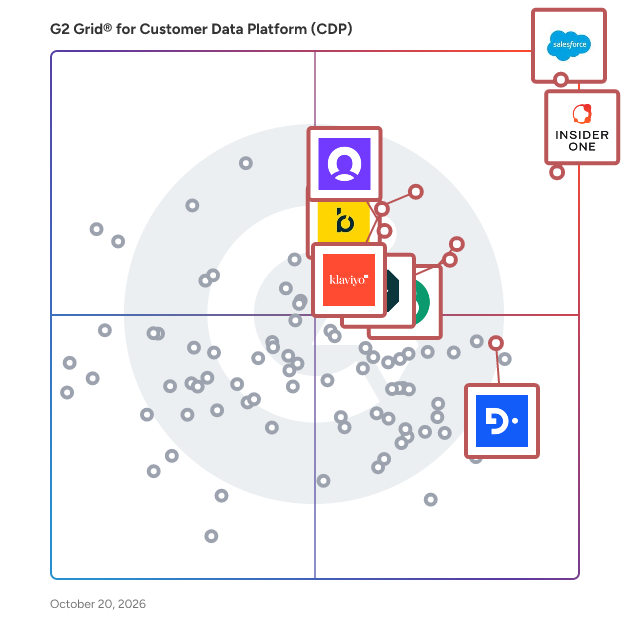
G2&#39;s top-rated Customer data platforms currently include Insider, Bloomreach, WebEngage, Fullstory, and Planhat.

According to G2’s Customer Data Statistics, 94% of business leaders say understanding customer needs is essential to delivering personalized experiences, and 78% of organizations say data silos are a major challenge—further validating the need for CDPs with specialized capabilities. ([_Source 1_](https://www.g2.com/articles/customer-data-statistics))

### What are customer data platforms?

G2 defines a [customer data platform](https://www.g2.com/categories/customer-data-platform-cdp) as a software system that collects, unifies, and organizes customer data from various sources into a single, centralized database. Its core purpose is to create a real-time, comprehensive view of each customer to help businesses deliver personalized marketing experiences and make data-driven decisions. Unlike traditional databases or marketing tools, CDP software automatically integrates both online and offline data, including first-party data such as website activity, mobile interactions, email engagement, transaction history, and sometimes third-party data from external sources.

Customer data platforms are designed to be used primarily by marketing teams, requiring minimal technical support, and offer the ability to segment customers, track behavior over time, and trigger automated actions based on that behavior. What makes a CDP unique is its ability to continuously update customer profiles as new data becomes available, structuring that information in a way that is actionable, whether for targeting ads, personalizing communications, or analyzing campaign performance.

A CDP is different from a CRM, data warehouse, or [DMP](https://www.g2.com/categories/data-management-platform-dmp). CRMs are generally focused on sales workflows and rely heavily on manual data entry, while CDPs automatically gather and maintain a broader range of behavioral and demographic data. Data warehouses are typically IT-managed systems for storing and querying historical data, lacking the real-time agility and marketing focus defining CDPs. DMPs, on the other hand, are built for advertising and primarily use anonymous third-party data to improve targeting, whereas CDPs focus on identifiable individuals and long-term relationship building.

By pulling together fragmented data from across platforms such as websites, mobile apps, social channels, and offline sources, a CDP empowers marketers to better understand customer journeys, personalize experiences, and drive long-term customer value.

The global customer data platform market is experiencing rapid growth as businesses prioritize unified customer data management and personalized marketing strategies. According to Fortune Business Insights, the CDP market was valued at USD 2.65 billion in 2024 and is projected to grow from USD 3.28 billion in 2025 to USD 12.96 billion by 2032, reflecting a compound annual growth rate (CAGR) of 21.7% during the forecast period. ([_Source 3_](https://www.fortunebusinessinsights.com/industry-reports/customer-data-platform-market-100633))

G2 currently covers 263 CDP products, with 1,521 reviews published in the last 12 months, making it one of the most reviewed and comprehensive software categories on our platform. ([_Source 2_](https://documentation.g2.com/docs/research-scoring-methodologies))

### What are the top reviewed customer data platforms on G2?

G2 scores the top-rated customer data platforms using a [proprietary algorithm](https://documentation.g2.com/docs/research-scoring-methodologies) that evaluates real-user satisfaction ratings and overall popularity based on review data. Here are the five highest-rated CDP products on G2 in this category:

#### 1. [Insider](https://www.g2.com/products/insider/reviews)

- Number of Reviews: 765
- Satisfaction: 100
- Market Presence: 99
- G2 Score: 100

#### 2. [Bloomreach](https://www.g2.com/products/bloomreach-bloomreach/reviews)

- Number of Reviews: 463
- Satisfaction: 76
- Market Presence: 93
- G2 Score: 85

#### 3. [WebEngage](https://www.g2.com/products/webengage/reviews)

- Number of Reviews: 174
- Satisfaction: 84
- Market Presence: 70
- G2 Score: 77

#### 4. [Fullstory](https://www.g2.com/products/fullstory/reviews)

- Number of Reviews: 179
- Satisfaction: 74
- Market Presence: 77
- G2 Score: 75

#### 5. [Planhat](https://www.g2.com/products/planhat/reviews)

- Number of Reviews: 312
- Satisfaction: 79
- Market Presence: 64
- G2 Score: 71

These rankings are determined by combining verified user ratings and publicly available web search popularity data:

- The **Satisfaction Score** measures user satisfaction with software products based on user feedback, review quality, quantity, and recency. It helps buyers easily understand how well a product meets user expectations. ([_Source 2_](https://documentation.g2.com/docs/research-scoring-methodologies))
- The **Market Presence Score** measures a product&#39;s prominence in its market. It combines data from G2 user reviews and external sources, focusing primarily on product-specific factors to reflect real-world popularity and vendor influence. ([_Source 2_](https://documentation.g2.com/docs/research-scoring-methodologies))
- G2 ranks products using a unique scoring system called the **G2 Score** , calculated from real user reviews, online data, and social signals. This score makes it easy to compare and evaluate different software products within each G2 category. ([_Source 2_](https://documentation.g2.com/docs/research-scoring-methodologies))

### Customer data platform pricing and cost considerations

Customer Data Platform (CDP) pricing can vary widely based on vendor offerings, business size, data volume, and the required features. Most CDPs follow a tiered pricing model, with costs typically scaling based on the number of customer profiles, data processed, or additional features like real-time personalization, advanced analytics, or integrations.

According to G2 data, the average annual price per license for CDPs is approximately _$1,294.70_. Pricing generally ranges from a minimum annual price of _$598.80_ per license to a maximum of _$4,272.00_ per license, depending on the product edition and feature set.

Entry-level CDPs for small to mid-sized businesses often start around _$600 to $1,200 per year_ per license. These plans typically include core features such as data collection, customer segmentation, and basic integrations with marketing tools.

Pricing can increase significantly for mid-market and enterprise-grade organizations, with advanced plans reaching _$4,000 or more per year_ per license. Higher pricing reflects support for larger data volumes, additional users, enhanced privacy and compliance features, AI-powered recommendations, and extensive customization options.

Beyond subscription costs, businesses should consider additional fees such as:

- Data storage overages
- Access to premium analytics or reporting modules
- API usage beyond included limits
- Implementation and onboarding services (which may range from several thousand to tens of thousands of dollars)

When evaluating CDP pricing, it’s important to factor in not only the base subscription fees but also the total cost of ownership. This includes internal resource requirements, training, integration complexity, and potential cost savings from replacing multiple disconnected systems with a unified customer data platform.

### Types of customer data providers on G2

The customer data platform market has matured, leading to the emergence of different types of platforms built for specific use cases. While all CDPs collect and unify customer data, they vary in how much functionality they provide beyond data management. Most fall into one of three categories:

- [Multiple Devices CDPs](https://www.g2.com/categories/customer-data-platform-cdp/f/multiple-devices): Multiple Devices CDPs are built to deliver consistent and personalized customer experiences across any device or channel. They help businesses track customer interactions across smartphones, tablets, desktops, and other connected devices to maintain a unified customer view. This type of CDP is best suited for organizations aiming to create seamless cross-device engagement, ensuring customers receive relevant messaging and experiences no matter how or where they interact with the brand.
- [Marketing Metrics-Focused CDPs](https://www.g2.com/categories/customer-data-platform-cdp/f/marketing-metrics): Marketing Metrics-focused CDPs provide advanced analytics and reporting capabilities that help businesses measure marketing performance and ROI. They enable organizations to track customer engagement, campaign effectiveness, and revenue attribution across multiple channels. This type of CDP is ideal for companies looking to gain deeper insights into their marketing efforts, optimize strategies, and make data-driven decisions while managing customer data in a centralized platform.
- [Recommendation Engine CDPs](https://www.g2.com/categories/customer-data-platform-cdp/f/recommendation-engine): Recommendation Engine CDPs use artificial intelligence and machine learning to deliver personalized content, product recommendations, and next-best actions across customer touchpoints. By analyzing customer behavior, preferences, and purchase history, they help businesses increase engagement and drive conversions. This type of CDP is well-suited for organizations aiming to enhance personalization strategies, improve product discovery, and deliver relevant experiences in real time across marketing channels.
- [Content Marketing CDPs](https://www.g2.com/categories/customer-data-platform-cdp/f/content-marketing): Content Marketing CDPs combine customer data management with content delivery tools to support personalized marketing at scale. They enable businesses to create, manage, and distribute content tailored to customer profiles, behaviors, and preferences. This type of CDP is ideal for organizations focused on automating content-driven campaigns, delivering targeted messaging across multiple channels, and driving customer engagement with personalized, data-informed content experiences.
- **Integration with AI Assistants** : As businesses adopt AI-powered customer service tools, CDPs provide accurate customer profiles and history. This integration enables AI assistants to offer more relevant, efficient, personalized interactions, enhancing overall customer satisfaction.

### Top customer data companies on G2 features rated by G2 reviewers

There is no single best customer data platform for every business. Different CDP features offer unique benefits depending on the organization’s goals, data complexity, and marketing maturity. These features can support users in several ways:

- Data enrichment: Use external data sources to enhance and complete customer profiles.
- Expandability: Add new data sources and adapt to changing data requirements over time.
- Content marketing: Manage and deliver content as part of personalized customer journeys.
- Multiple devices: Deliver consistent, personalized experiences across all customer devices.
- Marketing metrics: Measure the performance and ROI of marketing programs and campaigns.
- Predictive modeling: Forecast customer behaviors and outcomes using statistical models.
- Recommendation engine: Suggest next-best actions or products based on customer data and AI.

### Top CDP benefits identified by G2 reviewers

Effective customer data platform implementation can deliver a range of strategic business benefits, including:

**Ease of Use** : Users often highlight that these CDPs are intuitive and user-friendly, reducing the learning curve.

_“A customer data platform is a very potent, all-in-one platform that functions smoothly like clockwork. It has proven highly capable and effective for us, and we have witnessed consistent growth in CTR using their Smart Recommender.”_ - [Hung Ho, Digital Transformation Executive](https://www.g2.com/products/insider/reviews/insider-review-6920189)

**Data Management** : The ability to collect, unify, and manage customer data efficiently is a standout feature.

_“A customer data platform provides analytics and insights to help businesses understand user behavior, measure the performance of their digital experiences, and make data-driven decisions for optimization and personalization.”_ - [Hlengi Khanyile](https://www.g2.com/products/bloomreach-bloomreach/reviews/bloomreach-review-9184260)

**Personalization Capabilities:** Many users mention strong functionality around segmentation and delivering personalized customer experiences.

_“We send personalized notifications and messages that match each user’s interests and activity. This helps us keep users returning to the app by offering them exactly what they’re looking for. Personalization has made our connection with users stronger and more meaningful.”_ - [Sanjeev Arora, SDE - 1](https://www.g2.com/products/webengage/reviews/webengage-review-10487589)

**Automation** : Automating campaigns and data flows is frequently seen as a time-saver and a key value driver.

_“The customer portals are invaluable for tracking onboarding objectives with customers, keeping everyone aligned. Its robust automation capabilities allow us to create a wide range of alerts based on real-time data, ensuring we never miss critical updates.”_ - [Rocky Radu, Sr. Operations Engineer](http://ws/planhat-review-10533063)

**Customer Support** : Reviewers appreciate responsive and helpful support teams.

_“While the application is intuitive, there are a lot of hidden tricks and tips. Whenever I go to my support team with the question I&#39;m trying to answer, they do everything they can to help me answer that question.”_ - [Tim Oliver, Product Director - Analytics &amp; Data Science](https://www.g2.com/products/fullstory/reviews/fullstory-review-9719408)

### Top customer data platform challenges identified by G2 reviewers

Implementing a customer data software can drive significant marketing and operational value, but G2 user reviews highlight several common challenges that organizations may encounter. These challenges often relate to pricing, complexity, data integration, feature limitations, and support quality. Below are the most frequently reported hurdles, along with key questions to ask vendors and practical advice to address them:

**1. Pricing and cost complexity:** Reviewers frequently mention that CDP software can involve high costs, especially for advanced features, data volume, or enterprise-level use cases. Unclear pricing models or additional costs for integrations and support can be a barrier.

- **Essential questions to ask your CDP vendor** : What is included in your pricing tiers? Are there extra costs for data storage, API access, or integrations? How do costs scale with increasing customer profiles or data usage?
- **How to overcome the challenge** : Look for transparent pricing models that clearly outline what is included. Choose vendors that offer flexible, scalable pricing options aligned with your data needs and growth plans.

**2. Data complexity and steep learning curve:** Customer data platforms often require technical expertise to implement and operate effectively. Users report challenges managing data integration, identity resolution, and advanced segmentation features, especially without dedicated support.

- **Essential questions to ask your CDP vendor** : What onboarding, training, and documentation do you provide? Is your platform designed for marketers, or will technical teams need to be heavily involved? What customer success resources are available?
- **How to overcome the challenge** : Select CDPs that emphasize ease of use, intuitive interfaces, and strong customer enablement programs. Ensure that adequate training resources are available for both technical and non-technical users.

**3. Limited or underdeveloped features:** Many users cite missing features, lack of customization, or limitations in reporting and analytics tools as pain points that hinder their ability to fully leverage the CDP.

- **Essential questions to ask your CDP vendor** : What are your platform’s current core features, and how mature are they? Can you provide a product roadmap or outline of upcoming features? Are there limitations or known gaps in key areas like reporting, integrations, or personalization?
- **How to overcome the challenge** : Select a CDP vendor that is transparent about its product capabilities and development roadmap. During evaluation, prioritize platforms that actively engage with customer feedback and release regular feature updates. Consider whether the available features align with your highest-priority use cases, and avoid over-investing in platforms that require long wait times for critical functionality.

**4. Customer support quality:** Reviewers frequently note slow response times or inadequate assistance when solving technical issues, which negatively impacts their experience with the product.

- **Essential questions to ask your CDP vendor** : What support channels do you offer, such as email, live chat, phone, or dedicated account managers? What is your average response time for support inquiries? Do you provide guaranteed service levels through Service Level Agreements (SLAs)? What resources do you offer for onboarding, training, and ongoing customer success support?
- **How to overcome the challenge** : Evaluate CDP vendors based on proven customer support performance. Look for platforms with responsive, multi-channel support and clearly defined SLAs. Prioritize vendors that offer proactive customer success programs, training resources, and dedicated support contacts to ensure your team receives guidance during implementation and ongoing use.

**5. Data integration complexity:** Many users report difficulties integrating their CDP with existing tools, systems, and data sources. Challenges include limited pre-built connectors, complex API configurations, custom integration requirements, and inconsistent data formatting across platforms. Without seamless integration, a CDP’s ability to unify customer data and deliver insights is significantly reduced.

- **Essential questions to ask your CDP vendor** : What pre-built integrations do you offer with common tools like CRMs, marketing automation platforms, e-commerce systems, and analytics tools? How flexible is your API, and what technical resources are required for custom integrations? Do you provide support or services to help with integration setup and troubleshooting? How do you ensure data accuracy and consistency across connected systems?
- **How to overcome the challenge** : Prioritize CDPs that offer a wide range of pre-built integrations with your existing tools. Confirm that the platform provides clear API documentation, integration support, and technical resources to streamline setup. Engage internal IT teams early in the evaluation process to assess technical compatibility and avoid unexpected complexity during implementation.

### What are customer data platforms used for?

Customer Data Platforms (CDPs) are primarily used to unify customer data, improve marketing performance, and deliver personalized customer experiences. According to G2 reviewers, businesses rely on CDPs to collect and manage customer data from multiple sources and create a single, comprehensive customer view.

Common use cases include improving customer engagement, enabling personalized marketing campaigns, and optimizing customer journeys across channels. Many businesses use CDPs to track customer behavior, automate campaign delivery, and segment audiences for targeted messaging. CDPs also support reporting, real-time analytics, and help teams make data-driven decisions.

Reviewers frequently mention that CDPs help break down data silos, connect online and offline customer interactions, and increase operational efficiency in marketing, sales, and customer service teams.

### Who uses customer data platforms?

Customer data platform solutions are used by businesses to unify customer data, personalize marketing, and improve customer engagement across teams and channels.

- **Marketing teams** : Use CDPs to unify customer data, segment audiences, and personalize campaigns across channels.
- **Sales teams** : Access real-time customer profiles to identify leads, track activity, and deliver personalized outreach.
- **Customer experience teams** : Leverage CDPs to track customer interactions and provide consistent, personalized support.
- **Data and analytics teams** : Use CDPs to collect, analyze, and report on customer data from multiple sources.
- **Ecommerce and retail businesses** : Rely on CDPs to power personalized product recommendations and optimize customer journeys.
- **B2B and B2C companies** : Use CDPs to understand customer behavior, drive engagement, and improve marketing performance.

### Common customer data platform integrations

Customer data platforms integrate with a wide range of tools to collect, unify, and activate customer data across systems. Common integrations include:

- [CRM systems](https://www.g2.com/categories/crm): Connect customer relationship management tools to sync contact data, sales activity, and customer interactions.
- [Marketing automation platforms](https://www.g2.com/categories/marketing-automation): Integrate with email marketing, SMS, and campaign tools to deliver personalized messaging.
- [E-Commerce platforms](https://www.g2.com/categories/e-commerce-platforms): Sync product data, purchase history, and customer behavior from online stores.
- **Advertising platforms** : Connect with ad networks and social media channels to optimize audience targeting and ad personalization.
- [Analytics](https://www.g2.com/categories/analytics-platforms) **and** [BI tools](https://www.g2.com/categories/embedded-business-intelligence): Feed unified customer data into reporting platforms for deeper analysis and insights.
- [Data warehouses](https://www.g2.com/categories/data-warehouse) **and** [cloud storage](https://www.g2.com/categories/cloud-file-storage): Integrate with cloud data systems to centralize large volumes of structured and unstructured data.
- **Customer support tools** : Connect customer service platforms to provide personalized support based on complete customer profiles.

### **Software and services related to customer data platforms**

1. [Data warehouses](https://www.g2.com/categories/data-warehouse) store large volumes of integrated business data for reporting and analytics. Managed by IT teams, they focus on cross-departmental data rather than marketing-specific customer profiles.
2. [Data Management Platforms (DMP)](https://www.g2.com/categories/data-management-platform-dmp) collect third-party, cookie-based data for audience targeting and digital advertising. Unlike CDPs, DMPs focus on anonymous data and short-term storage for ad campaigns.
3. [CRM software](https://www.g2.com/categories/crm) store customer contact details, sales activity, and interaction history. While CRMs manage known customer records, CDPs unify data from all channels to create a complete customer view for marketing personalization.

### Future of customer data platforms

The future of customer data platforms will focus on deeper AI-driven personalization, stronger real-time data processing, expanded privacy and compliance features, and increased integration with emerging technologies to help businesses deliver more connected, predictive, and privacy-first customer experiences.

1. **AI-Powered Personalization** : CDPs are increasingly integrating artificial intelligence and machine learning to deliver hyper-personalized customer experiences in real time. By analyzing behavioral signals and customer preferences, businesses can tailor content, offers, and journeys dynamically. ​
2. **Real-Time Data Activation** : The growing demand for agility and responsiveness is driving CDPs to process and activate customer data instantly. Real-time decision-making helps brands respond to customer behavior as it happens, enhancing engagement and satisfaction. ​
3. **Privacy-First Data Collaboration** : With increasing data privacy regulations, CDPs are adopting technologies like data clean rooms that allow companies to analyze shared data sets without exposing personally identifiable information. This approach protects user privacy while maintaining valuable insights. ​
4. **Cross-Channel Customer Engagement** : CDPs are expanding beyond traditional marketing use cases, enabling personalized engagement across a growing number of touchpoints, including mobile apps, social media, e-commerce, and customer service platforms. This holistic approach ensures consistent messaging and experiences across all customer interactions. ​
5. **Integration with AI Assistants** : As businesses adopt AI-powered customer service tools, CDPs play a crucial role in providing accurate customer profiles and history. This integration enables AI assistants to offer more relevant, efficient, and personalized interactions, enhancing overall customer satisfaction. ([_Source 4_](https://www.cdpinstitute.org/news/customer-data-platform-growth-shifts-to-new-markets-cdp-institute-report/))

### Customer Data Platform (CDP) FAQs

#### What are customer data platforms?

A customer data platform, or CDP, is software that collects customer data from multiple sources such as websites, mobile apps, CRMs, email tools, and advertising platforms, then unifies it into a single, centralized customer profile. The goal of a CDP is to create a complete view of each customer by connecting identity and behavior across channels, even when data is fragmented.&amp;nbsp;

CDPs help teams segment audiences, personalize experiences, and activate customer data in other systems, such as [marketing automation](https://www.g2.com/categories/marketing-automation), [analytics](https://www.g2.com/categories/analytics-platforms), and [ad platforms](https://www.g2.com/categories/digital-advertising-tech), making them a foundational tool for customer-centric marketing and engagement.

#### CDP vs CRM: what are the differences?

The main difference between a CDP and a CRM is the type of data they manage and how that data is used. A [CRM](https://www.g2.com/categories/crm) is designed mainly for sales and customer service teams to manage relationships with known contacts by tracking communication history, storing contact and account details, and supporting pipeline workflows.&amp;nbsp;

A CDP is designed to unify both known and anonymous data across many systems, including real-time behavioral signals, and turn it into continuously updated customer profiles. While CRMs focus on relationship management and revenue workflows, CDPs focus on data unification, identity resolution, audience building, and activation for personalization and marketing performance. Many companies use both together, with CDPs enriching the CRM and improving targeting and customer engagement.

#### What is the best customer data platform?

There is no single best customer data platform for every business because the right choice depends on your goals, data complexity, customer journey, and existing tech stack. The best CDPs typically excel at unifying customer data across channels, accurately resolving customer identities, enabling real-time segmentation and activation, integrating smoothly with other tools, and supporting both privacy and governance requirements.&amp;nbsp;

A reliable way to evaluate the best CDP for your needs is to compare platforms based on verified user reviews, feature fit, and performance for companies of a similar size and industry. On G2, the leading CDPs are identified using verified customer feedback and satisfaction signals, which helps buyers see which tools perform best in real-world use cases.

The best CDP software are [Salesforce Data 360 (formerly Data Cloud)](https://www.g2.com/products/salesforce-data-360-formerly-data-cloud/reviews), [Insider One](https://www.g2.com/products/insider-one/reviews), and [Bloomreach](https://www.g2.com/products/bloomreach-bloomreach/reviews).

### Sources

1. [50+ Customer Data Statistics for Successful Marketing Plans](https://www.g2.com/articles/customer-data-statistics), G2
2. G2 reviews data: G2 reviews are sourced from verified software users and factor in satisfaction ratings, market presence, and real-time popularity data. Rankings in this guide are based on an analysis of G2 user reviews published within the last 12 months. For more details, read [G2’s full scoring methodology](https://documentation.g2.com/docs/research-scoring-methodologies).
3. [Customer Data Platform Market Size, Share &amp; Industry Analysis](https://www.fortunebusinessinsights.com/industry-reports/customer-data-platform-market-100633), Fortune Business Insights
4. [Customer Data Platform Growth Shifts to New Markets](https://www.cdpinstitute.org/news/customer-data-platform-growth-shifts-to-new-markets-cdp-institute-report/), CDP Institute