MongoDB Reviews & Product Details

Profile Status

This profile is currently managed by MongoDB but has limited features.

Are you part of the MongoDB team? Upgrade your plan to enhance your branding and engage with visitors to your profile!

Value at a Glance

Averages based on real user reviews.

Time to Implement

3 months

Return on Investment

11 months

MongoDB Integrations

(8)
Integration information sourced from real user reviews.

MongoDB Media

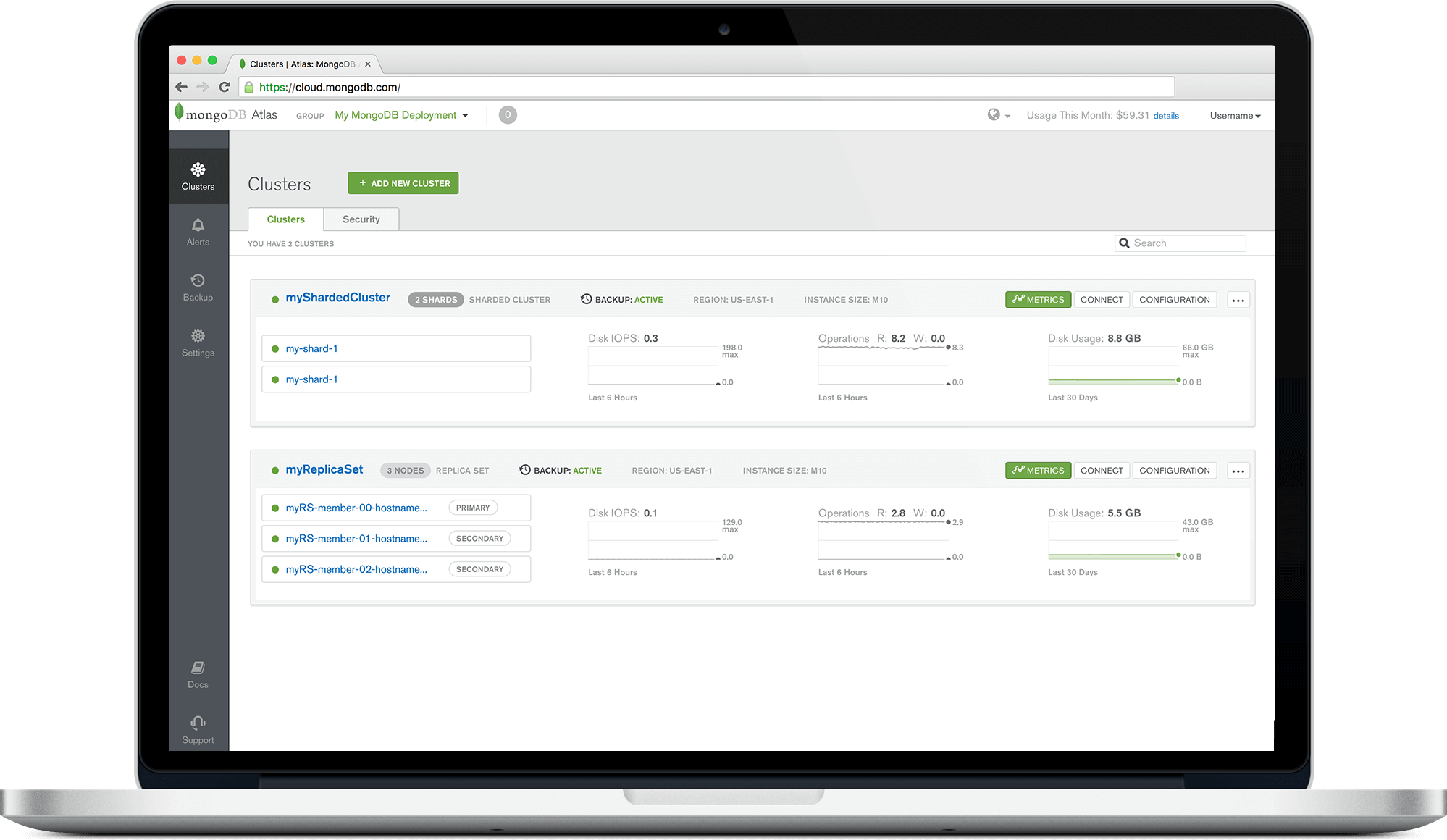
MongoDB Demo - MongoDB Atlas
MongoDB Atlas is a cloud-hosted MongoDB service engineered and run by the same team that builds the database. It incorporates operational best practices we’ve learned from optimizing thousands of deployments across startups and the Fortune 100. Build on MongoDB Atlas with confidence, knowing you ...
MongoDB Demo - MongoDB Compass
MongoDB Compass analyzes your documents and displays rich structures within your collections in a simple and intuitive GUI. It allows you to quickly visualize and explore your schema to understand the frequency, types and ranges of fields in your data set.
Product Avatar Image

Have you used MongoDB before?

Answer a few questions to help the MongoDB community

MongoDB Reviews (548)

View 1 Video Reviews
Reviews

MongoDB Reviews (548)

View 1 Video Reviews
4.5
548 reviews

Review Summary

Generated using AI from real user reviews
Users consistently praise MongoDB for its flexible schema and scalability, which allow for easy adaptation to changing data needs. The document-oriented structure simplifies data management, making it particularly appealing for developers working with unstructured data. However, some users note that the learning curve can be steep, especially for those transitioning from traditional SQL databases.

Pros & Cons

Generated from real user reviews
View All Pros and Cons
Search reviews
Filter Reviews
Clear Results
G2 reviews are authentic and verified.
Kesavan K.
KK
Senior System Engineer
Computer Software
Mid-Market (51-1000 emp.)
"MongoDB Makes Scaling Unstructured Data Easy"
What do you like best about MongoDB?

Mongodb is very useful.for unstructured data and scaling up will be more easy Review collected by and hosted on G2.com.

What do you dislike about MongoDB?

As of now there not much dislikes about mongodb Review collected by and hosted on G2.com.

Ronen S.
RS
Data analyst
Small-Business (50 or fewer emp.)
"Easy Solution for data management"
What do you like best about MongoDB?

Flexible schema, scalability and high performance ,built in horizontal scaling with sharding (distributes data across multiple servers). Review collected by and hosted on G2.com.

What do you dislike about MongoDB?

When it comes to data consistency compared to SQL, this system by default emphasizes availability and partition tolerance, as described by the CAP theorem. Achieving strong consistency is possible, but it demands careful setup, particularly in configuring write concerns and read preferences. Review collected by and hosted on G2.com.

Nashit H.
NH
Mentor/Faculty cum Developer
Education Management
Small-Business (50 or fewer emp.)
"Highly flexible and scalable database that can be used as general purpose db"
What do you like best about MongoDB?

The flexibility of its schema, and the amount of scalability it provides, be it horizontal or vertical. Aggregation & high availability makes it a wonderful choice. Extremely easy to use and integrate with any language, make it the first choice. Review collected by and hosted on G2.com.

What do you dislike about MongoDB?

Duplicity and no native joins are a concern. Review collected by and hosted on G2.com.

Fenil S.
FS
React devloper
Information Technology and Services
Small-Business (50 or fewer emp.)
"Secure and Familiar Database"
What do you like best about MongoDB?

MongoDB excels with its flexible document model, which allows for dynamic schema design—making it perfect for fast-paced development cycles and agile teams. Its JSON-like BSON storage format aligns well with modern JavaScript-based stacks like MERN, ensuring smooth data handling from front end to backend. The built-in horizontal scaling, support for geospatial queries, and full-text search are game-changers in terms of versatility. Review collected by and hosted on G2.com.

What do you dislike about MongoDB?

While MongoDB is powerful, it does have some drawbacks. It can consume significantly more storage than traditional relational databases due to its denormalized document structure. For applications with complex relationships, performance tuning requires careful indexing and schema design. Review collected by and hosted on G2.com.

Luca P.
LP
Chief Operations Officer DEQUA Studio | Formerly CTO in MarTech
Marketing and Advertising
Small-Business (50 or fewer emp.)
"Flexible and Scalable NoSQL Database"
What do you like best about MongoDB?

MongoDB’s document-oriented architecture uses JSON-like BSON documents for flexible, schema-less data storage. This allows dynamic adaptation to evolving data structures without rigid schema migrations.

Horizontal scalability via sharding efficiently distributes data across clusters, enabling seamless handling of massive datasets.

The aggregation framework supports complex data transformations, while built-in geospatial indexing and full-text search expand analytical capabilities.

Transaction support (from v4.0) ensures ACID compliance for multi-document operations. Review collected by and hosted on G2.com.

What do you dislike about MongoDB?

The transition from SQL can involve a steep learning curve, particularly for complex queries and aggregation pipelines.

Storage consumption is higher than relational databases due to denormalized data structures, impacting cost efficiency at scale.

While transactions are supported, performance tuning for complex ACID operations requires meticulous indexing and schema design. Review collected by and hosted on G2.com.

Naveen  V.
NV
Senior Site Reliability Engineer
Mid-Market (51-1000 emp.)
"Seamless Managed MongoDB Experience"
What do you like best about MongoDB?

Below are the features which i like the most about the db:

1. scalability and performance

2. robust managed service

3. flexible data model Review collected by and hosted on G2.com.

What do you dislike about MongoDB?

The only things that concern me are the cost of the D,B which can spike with the scale Review collected by and hosted on G2.com.

Vishal G.
VG
Node Js Developer (Cloud Associate)
Mid-Market (51-1000 emp.)
"MongoDb I am using in my current project for storing data into the database"
What do you like best about MongoDB?

Mongodb handled unstructure data so we can store any data and as compared to mysql mongodb is easy to understand. Review collected by and hosted on G2.com.

What do you dislike about MongoDB?

As I know everything is good as of now no cons from mu side Review collected by and hosted on G2.com.

Trung  N.
TN
Student
Small-Business (50 or fewer emp.)
"MongoDB review"
What do you like best about MongoDB?

MongoDB's flexibility and scalability are standout features. Its document-oriented model (using BSON) allows for dynamic, schema-less data structures, making it super versatile for evolving applications. This is especially helpful when dealing with unstructured or semi-structured data.

I also appreciate its horizontal scaling capabilities through sharding, which makes it suitable for handling large datasets and high-throughput applications. Features like indexing, aggregation pipelines, and replica sets for high availability are excellent for both performance and reliability.

For developers, tools like MongoDB Atlas (its cloud platform) simplify deployment and monitoring, saving tons of time. Review collected by and hosted on G2.com.

What do you dislike about MongoDB?

write amplification and potential performance issues under high write loads if not tuned properly. Its flexibility can also be a double-edged sword; having no enforced schema can lead to messy data structures if developers aren't disciplined. Review collected by and hosted on G2.com.

NIKKI .
N
AI Training Coding Expert
Information Technology and Services
Enterprise (> 1000 emp.)
"Scalable and Highly Flexible NoSQL Database"
What do you like best about MongoDB?

My favorite feature in this database is the flexibility of its use as well as the possibility to scale it. Because this model stores data in JSON-like formats, it is possible to handle unstructured and semi-structured data without having to prescribe very specific data models. This flexibility is especially good for application where the structure of the data being stored can change as time passes. Being able to scale a database horizontally through the use of sharding is one of MongoDB’s best features since it helps in loading big data and is efficient when dealing with traffic loads. Also, its complex query language; the power offered by the aggregation framework and indexing and data retrieval make the process very efficient and diverse. Moreover, features such as the MongoDB Atlas make cloud deployment and management easy and more enjoyable. MongoDB has gained many supporters of the community and had a great documentation, which makes it fit for today’s developments. Review collected by and hosted on G2.com.

What do you dislike about MongoDB?

Probably one of the biggest negatives of the MongoDB is its steep learning curve for those that have no prior experience with NoSQL systems or have recently migrated from SQL. On the positive side, it is also very flexible, allowing developers to easily create badly thought out schemas, which when the application starts getting a lot of use can slow down the performance immensely. Also, handling shard and replication in self-serving environment quite challenging and may need good understanding of structure. A third anotated limitation is the ACID properties of transactions while MongoDB has added support for these recently and to a far lesser extent than traditional relational database systems, it may not be suitable where high consistency is critical. Finally and as for the offering of MongoDB Atlas, which is a cloud managed service of MongoDB, there is a high likelihood of accumulating high costs particularly for those that are intending to develop jumbo scale applications for their start-ups or small business enterprises. Review collected by and hosted on G2.com.

DS
Frontend Developer
Information Services
Mid-Market (51-1000 emp.)
"Among the best database solutions out there, and it's really useful"
What do you like best about MongoDB?

Our application development and data analysis initiatives have relied heavily on MongoDB, a highly scalable and versatile NoSQL database, for its ability to efficiently manage unstructured and semi-structured data. The database provides a feature called indexing, which assigns a unique ID to each row. I've found this to be very helpful in today's world, where web services process massive amounts of data and better storage and resource utilization is essential; in addition, its aggregation capabilities allow me to perform complicated, resource-intensive queries at lightning speed. Review collected by and hosted on G2.com.

What do you dislike about MongoDB?

Starting and writing aggregations in MongoDB can be challenging without a good tool to guide you. You'll also need a basic understanding of databases and SQL queries to understand the concepts. Review collected by and hosted on G2.com.

Pricing Insights

Averages based on real user reviews.

Time to Implement

3 months

Return on Investment

11 months

Average Discount

13%

Perceived Cost

$$$$$

How much does MongoDB cost?

Data powered by BetterCloud.

Estimated Price

$$k - $$k

Per Year

Based on data from 26 purchases.

MongoDB Comparisons
Product Avatar Image
Redis Software
Compare Now
Product Avatar Image
Couchbase
Compare Now
Product Avatar Image
Cassandra
Compare Now
MongoDB Features
Data Model
Data Types
Built - In Search
Auto Sharding
Auto Recovery
Data Replication
Query Optimization
Role-Based Authorization
Authentication
Audit Logs
Product Avatar Image
MongoDB