





Introducing G2.ai, the future of software buying.Try now

Threat Hunting

by Holly Landis
Threat hunting is a cybersecurity technique that continually monitors networks for malicious activity. Learn how organizations stay protected from threats.

What is threat hunting?

Threat hunting is a proactive cybersecurity technique that regularly monitors networks and devices for potential cyber threats.

After bypassing a network’s first levels of security, criminals can easily go undetected, lurking for weeks, possibly months, before attacking or being discovered. Unlike threat detection, which is a more reactive approach, threat hunting anticipates where within the system these cyber criminals could be.

Through active monitoring using security information and event management (SIEM) software, IT and security teams identify suspicious activity and take action before a cyberattack takes place.

Types of threat hunting

Any threat hunting exercise assumes that cybercriminals are already within the network or device’s system. Investigations into these possible intruders fall into one of three categories. 

  • Hypothesis-driven is usually triggered by a new threat identified in a wider market. This could be industry-specific or based on the technologies a company is currently using. IT teams will gather information, usually through crowdsourcing, then investigate their own systems to see if anything suspicious has occurred.
  • Known indicators of compromise or attack go a step beyond hypothesis-driven investigations and use threat intelligence data to understand the motives or goals behind a possible attack. Indicators of compromise (IOCs) or indicators of attack (IOAs) are mapped and used as triggers for future malicious activity.
  • Machine learning uses data analysis techniques to review large amounts of information as a way of training artificial intelligence (AI) programs to detect inconsistencies and irregularities in data that could possibly suggest malicious activity.

Steps for a threat hunting investigation

Regardless of the threat hunting methodology used, companies have to complete five critical steps to ensure a successful investigation. 
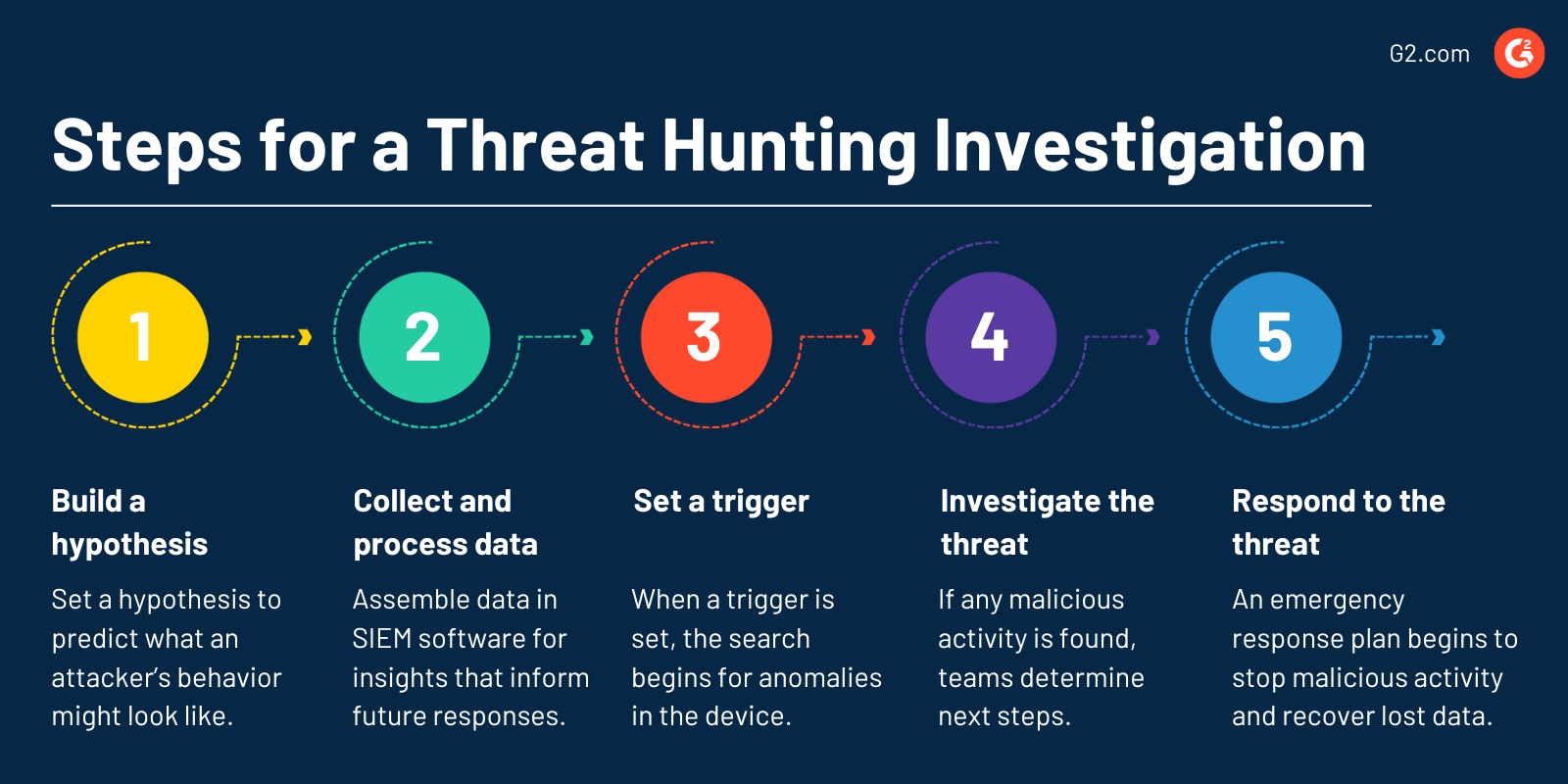
Steps for a Threat Hunting Investigation

  • Building a hypothesis. Like any scientific experiment, threat hunting requires a hypothesis to predict an attacker’s behavior. Ideas should be discussed across the team as they gather information about potential threats or types of activity to watch for.
  • Collecting and processing data. Assembling and centralizing data in SIEM software gives teams with a history of threats valuable insights that can inform future responses.
  • Setting a trigger. This is one of the most important parts of a threat hunt. Once a trigger is established, tracking searches for anomalies in the device or network. Any unusual behavior that’s triggered prompts teams to take further action.
  • Investigating the threat. If any malicious activity is found, teams look further into the trouble and determine their next steps.
  • Responding to the threat. At this point, the business’s emergency response plan should be rolled out to shut down any malicious activity, recover lost data, and patch security breaches.

Benefits of threat hunting

Taking a proactive stance toward cybersecurity is an organization’s best defense against criminals and the possibility of data loss. Threat hunting is also useful when it comes to:

  • Improving threat response times. As teams actively monitor for threats around the clock, they can quickly catch and deal with any shady activity. 
  • Reducing risk to the business. All digitally-run companies take risks with their information, but threat hunting can curb many of these by continually looking for and acting on problems before they escalate. Instead of a business losing all its data, threat hunters can prevent attacks or shut them down before too much information is lost.
  • Staying updated on the latest cyber threats. Proactive IT teams are more aware of current threats when they engage in threat hunting. Information and research is widely shared in cybersecurity communities, meaning teams stay updated on the most menacing activities.

Best practices for threat hunting

Organizations' threats are ever-changing, but establishing routines and best practices around threat hunting makes combating any cybersecurity issues much easier. Businesses should consider implementing best practices such as:

  • Establishing what’s normal for the company. Determining a baseline is essential when setting up new investigative systems. This means teams see when activity outside the norm takes place, which triggers further action.
  • Following a standard procedure. Many cybersecurity teams follow an effective workflow: observe, orient, decide, act (OODA). This naturally allows discussion and action to move swiftly when malicious activity arises.
  • Providing sufficient staff and resources. Effective cybersecurity protections can only happen when IT teams feel adequately supported. Having the necessary staff on the team to manage threats and act when problems happen significantly improves response times. Resources are also important, so training and software must also be considered.

Protect your business from malicious activity and cyber criminals with risk-based vulnerability management software.

Holly Landis
HL

Holly Landis

Holly Landis is a freelance writer for G2. She also specializes in being a digital marketing consultant, focusing in on-page SEO, copy, and content writing. She works with SMEs and creative businesses that want to be more intentional with their digital strategies and grow organically on channels they own. As a Brit now living in the USA, you'll usually find her drinking copious amounts of tea in her cherished Anne Boleyn mug while watching endless reruns of Parks and Rec.

Threat Hunting Software

This list shows the top software that mention threat hunting most on G2.

Carbon Black EDR is an incident response and threat hunting solution designed for security teams with offline environments or on-premises requirements. Carbon Black EDR continuously records and stores comprehensive endpoint activity data, so that security professionals can hunt threats in real time and visualize the complete attack kill chain. Top SOC teams, IR firms and MSSPs have adopted Carbon Black EDR as a core component of their detection and response capability stack. Carbon Black EDR is available via MSSP or directly via on-premises deployment, virtual private cloud or software as a service.

CrowdStrike Falcon endpoint protection unifies the technologies required to successfully stop breaches: next-generation antivirus, endpoint detection and response, IT hygiene, 24/7 threat hunting and threat intelligence. They combine to provide continuous breach prevention in a single agent.

Sophos provides cloud-native and AI-enhanced solutions secure endpoints (laptops, servers and mobile devices) and networks against evolving cybercriminal tactics and techniques, including automated and active-adversary breaches, ransomware, malware, exploits, data exfiltration, phishing, and more.

Microsoft Azure Sentinel is a cloud-native SIEM that provides intelligent security analytics for your entire enterprise, powered by AI.

The Huntress Managed Security Platform combines automated detection with human threat hunters—providing the software and expertise needed to stop advanced attacks.

Microsoft Defender for Endpoint is a unified platform for preventative protection, post-breach detection, automated investigation, and response.

AutoXDR™ converges multiple technologies (EPP, EDR, UBA, Deception, Network Analytics and vulnerability management), with a 24/7 cyber SWAT team, to provide unparalleled visibility and defend all domains of your internal network: endpoints, network, files and users, from all types of attacks.

Automate your malware analysis. Get answers quickly about any suspicious file, URL, endpoint or memory dump.

Trend Micro Vision One (XDR) collects and correlates deep activity data across multiple vectors - email, endpoints, servers, cloud workloads, and networks - enabling a level of detection and investigation that is difficult or impossible to achieve with SIEM or individual point solutions.

LogRhythm empowers organizations on six continents to successfully reduce risk by rapidly detecting, responding to, and neutralizing damaging cyberthreats

Stop known and unknown threats on all platforms using sophisticated machine learning and intelligent automation. SentinelOne predicts malicious behavior across all vectors, rapidly eliminates threats with a fully-automated incident response protocol, and adapts defenses against the most advanced cyber attacks.

Kaspersky Managed Detection and Response (MDR) is a comprehensive cybersecurity service designed to provide continuous, 24/7 protection against sophisticated threats that may bypass automated security measures. By leveraging advanced machine learning, proprietary threat intelligence, and the expertise of Kaspersky's security professionals, MDR ensures that organizations can detect, analyze, and respond to complex cyberattacks effectively. This service is particularly beneficial for businesses lacking the in-house resources or expertise to manage and respond to evolving cyber threats. Key Features and Functionality: - Advanced Protection Technologies: Utilizes cutting-edge security technologies, including unique threat intelligence and advanced machine learning, to prevent, detect, and respond to complex attacks. - Proactive Threat Hunting: Employs proprietary Indicators of Attack to identify stealthy, non-malware threats that may evade automated detection tools. - Automated and Guided Response: Offers both fully managed and guided threat disruption and containment, ensuring swift reactions while keeping all response actions under the organization's control. - Globally Recognized Expertise: Backed by over 25 years of targeted attack research, Kaspersky's threat hunting team provides unparalleled expertise in identifying and mitigating cyber threats. Primary Value and Solutions Provided: Kaspersky MDR addresses the critical need for continuous, expert-driven cybersecurity monitoring and response. By integrating advanced technologies with human expertise, it enables organizations to: - Enhance Security Posture: Achieve round-the-clock protection against even the most complex and evasive threats, ensuring business continuity and minimizing potential disruptions. - Optimize Resources: Alleviate the burden on internal security teams by outsourcing threat detection and response, allowing them to focus on strategic initiatives without compromising security. - Gain Comprehensive Visibility: Maintain real-time situational awareness with complete visibility into all observed malicious activities and the current protection status. - Ensure Flexibility and Scalability: Benefit from a solution that adapts to various industry sectors and organizational needs, offering fast, scalable deployment without the necessity for additional staff or expertise. In summary, Kaspersky Managed Detection and Response empowers organizations to fortify their defenses against sophisticated cyber threats through a blend of advanced technology and expert analysis, delivering a cost-effective and efficient approach to cybersecurity management.

As threats become more complex and persistent, alerts increase, and security teams are overwhelmed. Microsoft 365 Defender, part of Microsoft’s XDR solution, leverages the Microsoft 365 security portfolio to automatically analyze threat data across domains, building a complete picture of each attack in a single dashboard. With this breadth and depth of clarity defenders can now focus on critical threats and hunt for sophisticated breaches, trusting that the powerful automation in Microsoft 365 Defender detects and stops attacks anywhere in the kill chain and returns the organization to a secure state.

eSentire MDR is designed to keep organizations safe from constantly evolving cyberattacks that technology alone cannot prevent.

Let Blackpoint's managed SOC team monitor your network so you can focus on running your business.

Microsoft Defender for Business is an AI-powered, enterprise-grade security solution tailored for small and medium-sized businesses (SMBs) with up to 300 employees. It offers comprehensive protection against cyberthreats such as ransomware, malware, and phishing attacks across various platforms, including Windows, macOS, iOS, and Android devices. Designed for ease of use, it provides robust security features without the need for specialized IT expertise. Key Features and Functionality: - Threat and Vulnerability Management: Identifies, prioritizes, and remediates software vulnerabilities and misconfigurations, helping businesses proactively strengthen their security posture. - Attack Surface Reduction: Minimizes potential entry points for cyberattacks by enforcing security policies and configurations, thereby reducing the organization's exposure to threats. - Next-Generation Protection: Utilizes advanced antivirus and antimalware capabilities to detect and prevent a wide range of cyberthreats in real-time. - Endpoint Detection and Response (EDR): Monitors and analyzes endpoint activities to detect, investigate, and respond to advanced threats, ensuring swift remediation of security incidents. - Automated Investigation and Remediation: Leverages AI to automatically investigate alerts and take corrective actions, reducing the burden on IT teams and enhancing response times. Primary Value and User Benefits: Microsoft Defender for Business addresses the critical need for SMBs to protect their digital assets without the complexity and cost associated with enterprise solutions. By offering a comprehensive, easy-to-manage security platform, it enables businesses to safeguard their devices and data against evolving cyberthreats. The solution's automated features and intuitive design allow organizations to maintain robust security measures efficiently, even with limited IT resources. This ensures business continuity and instills confidence among customers and partners regarding the organization's commitment to cybersecurity.

Splunk Enterprise Security (ES) is a SIEM software that provides insight into machine data generated from security technologies such as network, endpoint, access, malware, vulnerability and identity information to enables security teams to quickly detect and respond to internal and external attacks to simplify threat management while minimizing risk and safeguarding business