Best Database as a Service (DBaaS) Providers for Small Business

How Many Database as a Service (DBaaS) Providers Products Does G2 Track?

Total Products under this Category: 143

Category Stats (Sep 2026)

  • Average Rating: 4.43/5 The average rating of products in this category, based on all submitted ratings
  • Top Trending Product: Supabase (+0.39%) - Among all products in this category, Supabase recorded the largest rating increase compared to last month

Last updated: September 15, 2026

How Does G2 Rank Database as a Service (DBaaS) Providers Products?

Why You Can Trust G2's Software Rankings:

  • 30 Analysts and Data Experts
  • 12,700+ Authentic Reviews
  • 143+ Products
  • Unbiased Rankings

G2's software rankings are built on verified user reviews, rigorous moderation, and a consistent research methodology maintained by a team of analysts and data experts. Each product is measured using the same transparent criteria, with no paid placement or vendor influence. While reviews reflect real user experiences, which can be subjective, they offer valuable insight into how software performs in the hands of professionals. Together, these inputs power the G2 Score, a standardized way to compare tools within every category.

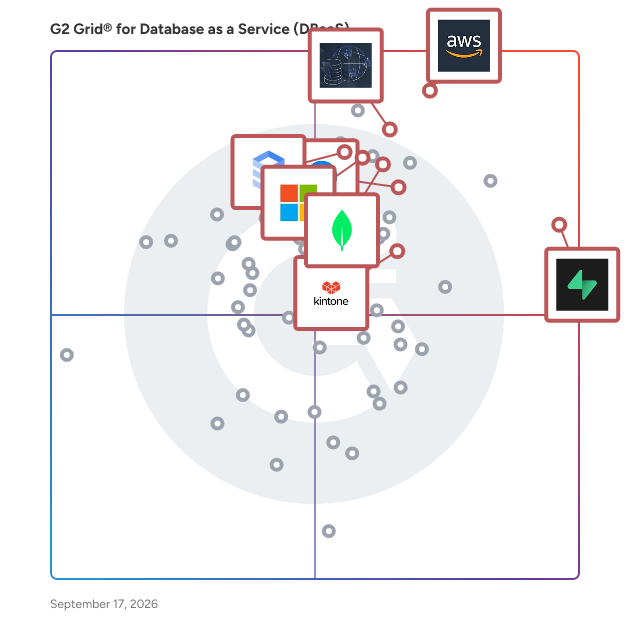
G2 Grid® for Database as a Service (DBaaS) Providers

G2 Grid® for Database as a Service (DBaaS) Providers plotting products by satisfaction and market presence

Highlighted products: Supabase, DigitalOcean, Amazon Relational Database Service (RDS), MongoDB Atlas, Google Cloud SQL, Amazon DynamoDB, Kintone, and Azure SQL Database.

Underlying data: [Grid® JSON](https://www.g2.com/categories/database-as-a-service-dbaas/grids.json?focus%5B%5D=supabase-supabase&focus%5B%5D=digitalocean&focus%5B%5D=amazon-relational-database-service-rds&focus%5B%5D=mongodb-atlas&focus%5B%5D=google-cloud-sql&focus%5B%5D=amazon-web-services-aws-amazon-dynamodb&focus%5B%5D=kintone&focus%5B%5D=azure-sql-database&segment=small-business)

Supabase

Supabase is an open-source backend-as-a-service (BaaS) platform that enables developers to build and scale applications efficiently without managing server infrastructure. Launched in 2020 as an alternative to Firebase, Supabase offers a suite of tools including a PostgreSQL database, authentication, real-time subscriptions, and storage capabilities. By leveraging the robustness of PostgreSQL, Supabase provides a scalable and secure foundation for modern web and mobile applications. Key Features and Functionality: - PostgreSQL Database: Each Supabase project includes a dedicated PostgreSQL database, offering full SQL support and advanced features such as JSON handling, full-text search, and vector support. - Instant APIs: Supabase automatically generates RESTful and GraphQL APIs based on your database schema, eliminating the need for manual coding and accelerating development. - Authentication and Authorization: The platform provides built-in user authentication with support for various sign-in methods, including email/password, magic links, and social logins. It also integrates seamlessly with PostgreSQL's Row Level Security for fine-grained access control. - Real-time Capabilities: Supabase enables real-time data synchronization via WebSockets, allowing applications to respond instantly to database changes. - Edge Functions: Developers can deploy serverless functions close to users for low-latency execution, facilitating scalable and efficient backend logic. - File Storage: Supabase offers scalable storage solutions for managing and serving files, complete with configurable access policies to ensure data security. Primary Value and User Solutions: Supabase addresses the challenges developers face in building and scaling applications by providing a comprehensive, open-source backend platform. It eliminates the complexities of managing server infrastructure, allowing developers to focus on creating feature-rich applications. With its real-time capabilities, robust authentication, and seamless integration with PostgreSQL, Supabase empowers developers to build secure, scalable, and responsive applications efficiently.

Average Rating: 4.6/5.0

Total Reviews: 229

How Do G2 Users Rate Supabase?

  • Application Performance: 9.2/10 (Category avg: 8.9/10)
  • Ease of Use: 9.1/10 (Category avg: 8.8/10)
  • Scalability: 9.4/10 (Category avg: 9.0/10)
  • Provisioning: 9.4/10 (Category avg: 8.8/10)

Who Is the Company Behind Supabase?

  • Seller: Supabase
  • Year Founded: 2020
  • HQ Location: Global, US
  • LinkedIn® Page: www.linkedin.com
    436 employees on LinkedIn®

Who Uses This Product?

  • Who Uses This: Founder, Software Engineer
  • Top Industries: Computer Software, Information Technology and Services
  • Company Size: 77% Small, 20% Medium

What Do G2 Reviewers Say About Supabase?

AI-generated summary from verified user reviews

Pros
  • Users find Supabase easy to use, enjoying its user-friendly interface and smooth integration with tools for app development.
  • Users appreciate the powerful design and easy integration of Supabase, enhancing their development experience significantly.
  • Users appreciate the user-friendly interface of Supabase, making it easy to set up and integrate smoothly.
  • Users love the easy integrations of Supabase, enhancing their workflow and speeding up project development seamlessly.
  • Users appreciate the seamless integrations of Supabase, enhancing the developer experience across various tools and projects.
Cons
  • Users feel that Supabase has beginner unfriendliness, citing complexity and limited resources for novice coders.
  • Users find the pricing expensive, especially for premium features that should be accessible to all users.
  • Users find Supabase has a high complexity that challenges novice coders and could benefit from better documentation.
  • Users face insufficient guidance in Supabase, making it challenging for novice coders to navigate the platform.
  • Users find that learning difficulties with Supabase arise due to its complexity and limited documentation for novices.

What Are Recent G2 Reviews of Supabase?

DigitalOcean

DigitalOcean is a cloud computing platform designed to assist businesses and developers in creating, deploying, and scaling applications efficiently. This infrastructure-as-a-service (IaaS) solution caters primarily to startups and growing digital enterprises, providing them with the essential tools and resources needed to establish a robust digital presence or develop innovative software products. By focusing on simplicity and user-friendliness, DigitalOcean enables users to navigate the complexities of cloud computing with ease. The target audience for DigitalOcean includes developers, entrepreneurs, and small to medium-sized businesses seeking reliable cloud solutions without the overhead of managing intricate infrastructure. The platform is particularly beneficial for those who prioritize rapid deployment and scalability, allowing them to focus on their core competencies—building and enhancing their applications. DigitalOcean's offerings are tailored to meet the needs of users at various stages of their development journey, from initial project setup to full-scale production environments. Key features of DigitalOcean include its straightforward user interface, which simplifies the process of launching virtual servers, known as Droplets. Users can choose from a variety of pre-configured images, including popular programming languages and frameworks, to expedite their development process. Additionally, DigitalOcean provides managed services such as databases and Kubernetes, allowing users to offload operational tasks and concentrate on application development. The platform also emphasizes security, offering features like automated backups, monitoring, and firewalls to protect user data and applications. Another significant benefit of DigitalOcean is its strong community support and extensive documentation. Users can access a wealth of tutorials, guides, and forums that facilitate knowledge sharing and problem-solving. This community-driven approach not only enhances the user experience but also fosters collaboration among developers, enabling them to learn from one another and share best practices. By combining powerful infrastructure with a supportive ecosystem, DigitalOcean stands out as a valuable resource for those looking to innovate in the digital landscape.

Average Rating: 4.6/5.0

Total Reviews: 744

How Do G2 Users Rate DigitalOcean?

  • Application Performance: 8.7/10 (Category avg: 8.9/10)
  • Ease of Use: 9.2/10 (Category avg: 8.8/10)
  • Scalability: 9.1/10 (Category avg: 9.0/10)
  • Provisioning: 8.7/10 (Category avg: 8.8/10)

Who Is the Company Behind DigitalOcean?

  • Seller: DigitalOcean
  • Year Founded: 2012
  • HQ Location: New York
  • Twitter: @digitalocean
    221,611 Twitter followers
  • LinkedIn® Page: www.linkedin.com
    2,476 employees on LinkedIn®
  • Ownership: NYSE: DOCN

Who Uses This Product?

  • Who Uses This: Software Engineer, CTO
  • Top Industries: Computer Software, Information Technology and Services
  • Company Size: 83% Small, 12% Medium

What Do G2 Reviewers Say About DigitalOcean?

AI-generated summary from verified user reviews

Pros
  • Users enjoy the ease of use of DigitalOcean, praising its intuitive interface for quick and efficient setup.
  • Users value the cost-effective pricing of DigitalOcean, appreciating predictable costs and excellent service reliability.
  • Users appreciate the affordable pricing of DigitalOcean, allowing for budget-friendly VPS options with transparent costs.
  • Users value DigitalOcean for its user-friendly interface and predictable pricing, making cloud deployment accessible and efficient.
  • Users value the easy setup of DigitalOcean, allowing quick deployment of applications without complexity.
Cons
  • Users find the limited features of DigitalOcean's dashboard and analytics insufficient for comprehensive resource management.
  • Users find DigitalOcean relatively expensive, especially for scaling and in certain regions like Brazil.
  • Users find the missing advanced features and detailed analytics on DigitalOcean limiting for power users and deployments.
  • Users find resource limitations in DigitalOcean's storage and Linux distributions compared to competitors like Amazon S3 and Vultr.
  • Users experience usage limitations with DigitalOcean, especially regarding dashboard performance and lack of advanced metrics.

What Are Recent G2 Reviews of DigitalOcean?

What Are G2 Users Discussing About DigitalOcean?

MongoDB Atlas

MongoDB Atlas is a developer data platform that provides a tightly integrated collection of data and application infrastructure building blocks to enable enterprises to quickly deploy bespoke architectures to address any application need. Atlas supports transactional, full-text search, vector search, time series and stream processing application use cases across mobile, distributed, event-driven, and serverless architectures.

Average Rating: 4.5/5.0

Total Reviews: 852

How Do G2 Users Rate MongoDB Atlas?

  • Application Performance: 9.2/10 (Category avg: 8.9/10)
  • Ease of Use: 8.8/10 (Category avg: 8.8/10)
  • Scalability: 9.2/10 (Category avg: 9.0/10)
  • Provisioning: 8.8/10 (Category avg: 8.8/10)

Who Is the Company Behind MongoDB Atlas?

  • Seller: MongoDB
  • Year Founded: 2007
  • HQ Location: New York
  • Twitter: @MongoDB
    503,172 Twitter followers
  • LinkedIn® Page: www.linkedin.com
    8,041 employees on LinkedIn®
  • Ownership: NASDAQ: MDB

Who Uses This Product?

  • Who Uses This: Software Engineer, Senior Software Engineer
  • Top Industries: Computer Software, Information Technology and Services
  • Company Size: 46% Small, 29% Large

What Do G2 Reviewers Say About MongoDB Atlas?

AI-generated summary from verified user reviews

Pros
  • Users appreciate the intuitive UI of MongoDB Atlas, enhancing their database management experience significantly.
  • Users value the scalability of MongoDB Atlas, noting its ease in managing clusters and diverse data structures.
  • Users appreciate the intuitive UI of MongoDB Atlas, which simplifies database management and enhances user experience.
  • Users appreciate the intuitive UI and documentation of MongoDB Atlas, enhancing user-friendly database management and efficiency.
  • Users highly value the reliability of MongoDB Atlas, consistently appreciating its excellent uptime and seamless performance.
Cons
  • Users find the pricing of MongoDB Atlas excessively high, leading to frustration with unexpected costs and poor performance.
  • Users express frustration over unclear pricing structures, leading to unexpected costs and insufficient support throughout their experience.
  • Users find MongoDB Atlas expensive, citing high costs for performance, support, and complex billing issues.
  • Users experience high memory usage with MongoDB Atlas, leading to performance issues and unexpected costs.
  • Users frequently report latency issues and unwanted slowdowns in performance during data operations with MongoDB Atlas.

What Are Recent G2 Reviews of MongoDB Atlas?

What Are G2 Users Discussing About MongoDB Atlas?

Amazon Relational Database Service (RDS)

Amazon Relational Database Service (Amazon RDS) makes it easy to set up, operate, and scale a relational database in the cloud. It provides cost-efficient and resizable capacity while managing time-consuming database administration tasks such as hardware provisioning, database setup, patching and backups. It frees you up to focus on your apps so you can give them the better performance, availability, security, and compatibility they need. Amazon RDS is available on 6 familiar database instances: Amazon Aurora, MySQL, PostgreSQL, MariaDB, Oracle Database and SQL Server engines. This means that the code, applications, and tools you already use today with your existing databases can be used with Amazon RDS. Amazon RDS automatically patches the database software and backs up your database, storing the backups for a user-defined retention period and enabling point-in-time recovery. You benefit from the flexibility of being able to scale the compute resources or storage capacity associated with your relational database instance via a single API call. In addition, Amazon RDS makes it easy to use replication to enhance availability and reliability for production databases. Amazon RDS for MySQL also enables you to scale out beyond the capacity of a single database deployment for read-heavy database workloads. As with all Amazon Web Services, there are no up-front investments required, and you pay only for the resources you use.

Average Rating: 4.5/5.0

Total Reviews: 866

How Do G2 Users Rate Amazon Relational Database Service (RDS)?

  • Application Performance: 8.8/10 (Category avg: 8.9/10)
  • Ease of Use: 8.8/10 (Category avg: 8.8/10)
  • Scalability: 9.1/10 (Category avg: 9.0/10)
  • Provisioning: 8.8/10 (Category avg: 8.8/10)

Who Is the Company Behind Amazon Relational Database Service (RDS)?

  • Seller: Amazon Web Services (AWS)
  • Year Founded: 2006
  • HQ Location: Seattle, WA
  • Twitter: @awscloud
    2,232,483 Twitter followers
  • LinkedIn® Page: www.linkedin.com
    147,094 employees on LinkedIn®
  • Ownership: NASDAQ: AMZN

Who Uses This Product?

  • Who Uses This: DevOps Engineer, Software Engineer
  • Top Industries: Information Technology and Services, Computer Software
  • Company Size: 38% Medium, 34% Large

What Do G2 Reviewers Say About Amazon Relational Database Service (RDS)?

AI-generated summary from verified user reviews

Pros
  • Users find Amazon RDS to be extremely easy to use, streamlining deployment and saving valuable setup time.
  • Users appreciate the effortless scalability of Amazon RDS, enhancing application performance during unexpected traffic spikes.
  • Users appreciate the easy setup of Amazon RDS, enabling quick deployment and hassle-free management for their applications.
  • Users appreciate the automated backup services of Amazon RDS, allowing them to focus on application development without data loss worries.
  • Users appreciate the high availability and reliability of Amazon RDS, simplifying management and ensuring data safety.
Cons
  • Users find the cost of Amazon RDS quite high, especially with charges accruing for unused instances.
  • Users find the complex naming conventions in AWS services frustrating, making it hard for newcomers to navigate.
  • Users experience performance issues with Amazon RDS, including latency and variability in multi-tenant environments.
  • Users note that cost issues can escalate quickly, with unexpected charges making budgeting challenging.
  • Users experience latency issues with Amazon RDS, especially noticeable during replication and with larger databases.

What Are Recent G2 Reviews of Amazon Relational Database Service (RDS)?

What Are G2 Users Discussing About Amazon Relational Database Service (RDS)?

Google Cloud SQL

Cloud SQL is a fully-managed managed relational database service for MySQL, PostgreSQL, and SQL Server with rich extension collections, configuration flags, and developer ecosystems.

Average Rating: 4.5/5.0

Total Reviews: 355

How Do G2 Users Rate Google Cloud SQL?

  • Application Performance: 9.2/10 (Category avg: 8.9/10)
  • Ease of Use: 9.2/10 (Category avg: 8.8/10)
  • Scalability: 9.2/10 (Category avg: 9.0/10)
  • Provisioning: 8.9/10 (Category avg: 8.8/10)

Who Is the Company Behind Google Cloud SQL?

  • Seller: Google
  • Year Founded: 1998
  • HQ Location: Mountain View, CA
  • Twitter: @google
    31,899,995 Twitter followers
  • LinkedIn® Page: www.linkedin.com
    301,144 employees on LinkedIn®
  • Ownership: NASDAQ:GOOG

Who Uses This Product?

  • Who Uses This: Software Engineer, Data Engineer
  • Top Industries: Information Technology and Services, Computer Software
  • Company Size: 41% Medium, 34% Small

What Do G2 Reviewers Say About Google Cloud SQL?

AI-generated summary from verified user reviews

Pros
  • Users appreciate the efficiency and automation of Google Cloud SQL for hassle-free database management and maintenance.
  • Users value the seamless integration of Google Cloud SQL with Google Cloud services, enhancing scalability and performance.
  • Users appreciate the ease of use of Google Cloud SQL, simplifying database management without infrastructure worries.
  • Users value the easy integrations of Google Cloud SQL, enhancing efficiency and convenience for database management.
  • Users commend the scalability of Google Cloud SQL, appreciating its seamless integration and efficient management of databases.
Cons
  • Users find Google Cloud SQL to be expensive, especially for storage and smaller projects, making it less accessible.
  • Users find Google Cloud SQL to be expensive, especially as workloads increase, straining budgets and resources.
  • Users face scaling issues with Google Cloud SQL due to slow support and manual adjustments for changing workloads.
  • Users find the complex pricing of Google Cloud SQL challenging, leading to confusion and difficulty in cost prediction.
  • Users find Google's pricing to be confusing, especially with unexpected usage spikes affecting cost predictions.

What Are Recent G2 Reviews of Google Cloud SQL?

What Are G2 Users Discussing About Google Cloud SQL?

Amazon DynamoDB

Amazon DynamoDB is a pioneering NoSQL, fully managed, serverless database with limitless scalability and single-digit millisecond latency performance enabling customers to develop modern, microservice-based applications through a simple API. Customers enjoy the benefits of DynamoDB’s fully-managed service including broad compliance standards, security integration with AWS Identity and Access Management and numerous disaster recovery services. With DynamoDB Global Tables, customers have a 99.999% highly available, multi-Region, multi-active database supporting local reads and writes for globally distributed users. DynamoDB provides cost management features such as scale-to-zero, Time to Live (TTL) for aging data out, and multiple pricing models including a free tier.

Average Rating: 4.4/5.0

Total Reviews: 498

How Do G2 Users Rate Amazon DynamoDB?

  • Application Performance: 9.0/10 (Category avg: 8.9/10)
  • Ease of Use: 8.7/10 (Category avg: 8.8/10)
  • Scalability: 9.3/10 (Category avg: 9.0/10)
  • Provisioning: 8.8/10 (Category avg: 8.8/10)

Who Is the Company Behind Amazon DynamoDB?

  • Seller: Amazon Web Services (AWS)
  • Year Founded: 2006
  • HQ Location: Seattle, WA
  • Twitter: @awscloud
    2,232,483 Twitter followers
  • LinkedIn® Page: www.linkedin.com
    147,094 employees on LinkedIn®
  • Ownership: NASDAQ: AMZN

Who Uses This Product?

  • Who Uses This: Software Engineer, Senior Software Engineer
  • Top Industries: Computer Software, Information Technology and Services
  • Company Size: 35% Large, 34% Medium

What Do G2 Reviewers Say About Amazon DynamoDB?

AI-generated summary from verified user reviews

Pros
  • Users value the exceptional scalability of Amazon DynamoDB, enabling consistent performance during unpredictable workloads and high traffic.
  • Users appreciate the ease of use of Amazon DynamoDB, benefiting from its fully managed and scalable features.
  • Users appreciate the cost efficiency of Amazon DynamoDB, saving time and reducing operational efforts significantly.
  • Users value the low-latency performance of Amazon DynamoDB, ensuring rapid responses for high-traffic applications.
  • Users value the fully managed services of Amazon DynamoDB, significantly reducing operational burdens and enhancing efficiency.
Cons
  • Users express concerns about the expensive costs associated with DynamoDB's pay-per-request model and configuration complexities.
  • Users face challenges with query complexity, as inefficient designs can lead to high costs and throttling issues.
  • Users find Amazon DynamoDB complex for newcomers, requiring extensive learning and proper data modeling to avoid issues.
  • Users find the learning curve steep, making data modeling and queries challenging for newcomers to DynamoDB.
  • Users face cost management challenges with DynamoDB, needing careful optimization to prevent unexpected expenses.

What Are Recent G2 Reviews of Amazon DynamoDB?

What Are G2 Users Discussing About Amazon DynamoDB?

Kintone

Kintone is a no-code business application platform designed to empower non-technical users to create robust applications, workflows, and databases tailored to their teams and organizations. By utilizing a user-friendly interface that emphasizes clicks over coding, Kintone enables individuals to develop applications that streamline business processes, enhance collaboration on projects and tasks, and facilitate the reporting of complex data with ease. This platform is particularly beneficial for business users who require immediate solutions without the need for extensive programming knowledge. Kintone offers a wide array of pre-built applications that cater to various use cases, including customer relationship management (CRM), project management, inventory management, and more. These templates allow users to hit the ground running and adapt the applications to their specific needs, significantly reducing the time and effort required to implement new systems. Kintone's target audience includes small to medium-sized businesses, project managers, team leaders, and any professional looking to optimize their workflow without relying on IT departments or external developers. The no-code approach democratizes app development, allowing users from diverse backgrounds to participate in creating solutions that address their unique challenges. This inclusivity fosters a culture of innovation within organizations, as team members can contribute ideas and improvements based on their firsthand experiences. Key features of Kintone include customizable dashboards, automated workflows, and real-time collaboration tools. Users can design dashboards that provide insights into their projects and data at a glance, while automated workflows help eliminate repetitive tasks, ensuring that team members can focus on higher-value activities. The platform also supports real-time collaboration, enabling teams to work together seamlessly, share updates, and track progress on projects without the need for constant meetings or email exchanges. Kintone stands out in the no-code platform category by offering a flexible and scalable solution that grows with organizations. Its ability to integrate with other tools and services further enhances its functionality, allowing users to create a comprehensive ecosystem that meets their evolving business needs. By providing a powerful yet accessible platform for app development, Kintone empowers users to take control of their workflows and drive efficiency within their teams.

Average Rating: 4.6/5.0

Total Reviews: 263

How Do G2 Users Rate Kintone?

  • Application Performance: 9.1/10 (Category avg: 8.9/10)
  • Ease of Use: 8.9/10 (Category avg: 8.8/10)
  • Scalability: 9.1/10 (Category avg: 9.0/10)
  • Provisioning: 9.2/10 (Category avg: 8.8/10)

Who Is the Company Behind Kintone?

  • Seller: Kintone
  • Company Website:
  • Year Founded: 1997
  • HQ Location: San Francisco, CA
  • Twitter: @kintone
    2,101 Twitter followers
  • LinkedIn® Page: www.linkedin.com
    84 employees on LinkedIn®

Who Uses This Product?

  • Who Uses This: CEO, Executive Director
  • Top Industries: Non-Profit Organization Management, Information Technology and Services
  • Company Size: 73% Small, 22% Medium

What Do G2 Reviewers Say About Kintone?

AI-generated summary from verified user reviews

Pros
  • Users love Kintone for its ease of use, enabling workflow creation without needing a dedicated developer.
  • Users value Kintone's outstanding customer support, noting their clear communication and quick, effective issue resolution.
  • Users value Kintone’s customization and centralized workflows, significantly improving communication and efficiency across teams.
  • Users appreciate the high degree of customization Kintone offers, allowing tailored solutions to fit unique business needs.
  • Users value Kintone's customization options that streamline workflows and enhance efficiency tailored to specific business needs.
Cons
  • Users note missing features, such as improved dropdowns and basic accounting tools, which hinder overall functionality.
  • Users find Kintone's poor interface design impacts usability, making it less friendly and attractive for everyday tasks.
  • Users find Kintone's limited customization frustrating, as it hinders effective data management and integration with other apps.
  • Users find Kintone's limited features frustrating, particularly in integration and advanced customization capabilities.
  • Users find Kintone's poor usability frustrating due to its outdated interface and lack of intuitive design.

What Are Recent G2 Reviews of Kintone?

What Are G2 Users Discussing About Kintone?

Azure SQL Database

Azure SQL Database is a fully managed, intelligent relational database service built on the Microsoft SQL Server engine, designed to support modern cloud applications. It offers scalability, high availability, and robust security features, enabling developers to build and maintain applications without the complexities of infrastructure management. Key Features and Functionality: - Hyperscale Storage: Rapidly scale storage resources to meet demand, supporting large databases with up to 100 TB capacity. - Serverless Compute: Automatically adjust compute resources based on workload needs, optimizing performance and cost. - Built-in Intelligence: Utilize AI-driven features for performance tuning, threat detection, and advanced security measures. - High Availability: Ensure business continuity with automatic backups, geo-replication, and a 99.99% uptime SLA. - Advanced Security: Protect data with multi-layered security, including encryption, access controls, and compliance with over 100 certifications. Primary Value and Solutions Provided: Azure SQL Database simplifies database management by automating routine tasks such as patching, backups, and monitoring, allowing developers to focus on application development. Its scalability and performance capabilities support applications of varying sizes, from small web apps to large enterprise solutions. The integration with Azure services and support for AI and machine learning workloads enable the creation of intelligent applications. Additionally, its comprehensive security and compliance features ensure data protection and regulatory adherence, making it a reliable choice for businesses seeking a robust cloud-based database solution.

Average Rating: 4.5/5.0

Total Reviews: 232

How Do G2 Users Rate Azure SQL Database?

  • Application Performance: 8.9/10 (Category avg: 8.9/10)
  • Ease of Use: 8.8/10 (Category avg: 8.8/10)
  • Scalability: 9.1/10 (Category avg: 9.0/10)
  • Provisioning: 8.7/10 (Category avg: 8.8/10)

Who Is the Company Behind Azure SQL Database?

  • Seller: Microsoft
  • Year Founded: 1975
  • HQ Location: Redmond, Washington
  • Twitter: @microsoft
    13,091,739 Twitter followers
  • LinkedIn® Page: www.linkedin.com
    232,750 employees on LinkedIn®
  • Ownership: MSFT

Who Uses This Product?

  • Who Uses This: Software Engineer
  • Top Industries: Information Technology and Services, Computer Software
  • Company Size: 40% Large, 33% Medium

What Do G2 Reviewers Say About Azure SQL Database?

AI-generated summary from verified user reviews

Pros
  • Users value the automatic scaling of Azure SQL Database, enhancing database management without needing additional hardware.
  • Users value the seamless integrations of Azure SQL Database, enhancing connectivity and functionality across various technologies.
  • Users appreciate the ease of use of Azure SQL Database, enabling seamless integration with various technologies.
  • Users appreciate the easy integrations of Azure SQL Database, enabling seamless connectivity across various technologies effortlessly.
  • Users appreciate the ease of use and rich features of Azure SQL Database, making data management straightforward and efficient.
Cons
  • Users find Azure SQL Database expensive, especially for large databases and high-performance needs.
  • Users face significant complexity issues with Azure SQL Database, particularly when managing billing and unexpected costs.
  • Users find cost management complexity and confusing product naming in Azure SQL Database challenging, especially for newcomers.
  • Users find Azure SQL Database a challenge due to limited database support, especially in cross-database querying and features.
  • Users experience a steep learning curve with Azure SQL Database, especially due to complexity in pricing and advanced features.

What Are Recent G2 Reviews of Azure SQL Database?

What Are G2 Users Discussing About Azure SQL Database?

Boost.space

Boost.space is the #1 AI-Ready Data Sync platform on G2—recognized with over 100 customer-voted badges. ⭐️ Today's enterprises are investing heavily in AI, but most initiatives fail. Why? Because AI is "stateless"—it has no memory—and it's running on chaotic data fragmented across hundreds of applications. This data chaos costs companies an average of $15 million annually and wastes nearly 12 hours per employee every week.   Boost.space solves this foundational problem by creating a new category of enterprise infrastructure: the AI Memory Layer. We are not just another application; we are the persistent, unified memory that your entire AI and automation ecosystem needs to function intelligently. Our platform connects to over 2,400 apps to dismantle data silos, creating a single source of truth (SSOT) for all your business data. But unlike passive data warehouses, Boost.space is an active, read-write memory. Our real-time, three-way synchronization engine allows AI agents to not only read unified data but also act on it by writing changes back to your operational tools. At the heart of this is our Model Context Protocol (MCP), an "AI-Ready USB-C Port" for your enterprise that allows you to prompt your business in natural language. Whether you're building an AI-Ready PIM for e-commerce or an AI-Ready CDP for marketing, Boost.space provides the essential foundation, trusted by leaders like ŠKODA to make their data AI-ready.

Average Rating: 4.6/5.0

Total Reviews: 327

How Do G2 Users Rate Boost.space?

  • Application Performance: 8.9/10 (Category avg: 8.9/10)
  • Ease of Use: 7.3/10 (Category avg: 8.8/10)
  • Scalability: 8.9/10 (Category avg: 9.0/10)
  • Provisioning: 8.9/10 (Category avg: 8.8/10)

Who Is the Company Behind Boost.space?

  • Seller: Boost.space s.r.o.
  • Year Founded: 2017
  • HQ Location: Prague, CZ
  • Twitter: @boostspace
    79 Twitter followers
  • LinkedIn® Page: www.linkedin.com
    35 employees on LinkedIn®

Who Uses This Product?

  • Who Uses This: CEO, Founder
  • Top Industries: Marketing and Advertising, Consulting
  • Company Size: 99% Small, 1% Medium

What Do G2 Reviewers Say About Boost.space?

AI-generated summary from verified user reviews

Pros
  • Users value the seamless integrations of Boost.space, enhancing productivity by connecting multiple platforms effortlessly.
  • Users benefit from Boost.space's automation capabilities, efficiently streamlining tasks and reducing operational costs.
  • Users love the seamless integrations of Boost.space, which unify workflows and enhance collaboration across multiple platforms.
  • Users appreciate the excellent integration options and user-friendly interface of Boost.space, simplifying their workflow.
  • Users appreciate the easy integration capabilities of Boost.space, enabling seamless connectivity between multiple platforms.
Cons
  • Users report a high learning curve with Boost.space, requiring time and technical skills to effectively use the platform.
  • Users note a steep learning curve initially, requiring time to adapt and understand the interface effectively.
  • Users find the learning difficulty of Boost.space challenging, requiring significant time investment to navigate its complexities.
  • Users find the complex setup challenging, often needing time and potential technical support to integrate effectively.
  • Users find the beginner difficulty daunting, emphasizing the need for better onboarding and tutorials to ease navigation.

What Are Recent G2 Reviews of Boost.space?

Amazon Neptune

Amazon Neptune is a fast, reliable, fully-managed graph database service that makes it easy to build and run applications that work with highly connected datasets. The core of Amazon Neptune is a purpose-built, high-performance graph database engine optimized for storing billions of relationships and querying the graph with milliseconds latency. Amazon Neptune supports popular graph models Property Graph and W3C's RDF, and their respective query languages Apache TinkerPop Gremlin and SPARQL, allowing you to easily build queries that efficiently navigate highly connected datasets. Neptune powers graph use cases such as recommendation engines, fraud detection, knowledge graphs, drug discovery, and network security. Amazon Neptune is highly available, with read replicas, point-in-time recovery, continuous backup to Amazon S3, and replication across Availability Zones. Neptune is secure with support for encryption at rest. Neptune is fully-managed, so you no longer need to worry about database management tasks such as hardware provisioning, software patching, setup, configuration, or backups.

Average Rating: 4.3/5.0

Total Reviews: 31

How Do G2 Users Rate Amazon Neptune?

  • Application Performance: 9.1/10 (Category avg: 8.9/10)
  • Ease of Use: 9.1/10 (Category avg: 8.8/10)
  • Scalability: 8.8/10 (Category avg: 9.0/10)
  • Provisioning: 9.2/10 (Category avg: 8.8/10)

Who Is the Company Behind Amazon Neptune?

  • Seller: Amazon Web Services (AWS)
  • Year Founded: 2006
  • HQ Location: Seattle, WA
  • Twitter: @awscloud
    2,232,483 Twitter followers
  • LinkedIn® Page: www.linkedin.com
    147,094 employees on LinkedIn®
  • Ownership: NASDAQ: AMZN

Who Uses This Product?

  • Top Industries: Computer Software
  • Company Size: 65% Small, 26% Large

What Are Recent G2 Reviews of Amazon Neptune?

CockroachDB

Overview Cockroach Labs is the creator of CockroachDB, the cloud-native, resilient, distributed SQL database enterprises worldwide trust to run mission-critical AI and other applications that scale fast, avert and survive disaster, and thrive everywhere. It runs on the Big 3 clouds, on prem, and in hybrid configurations powering Fortune 500, Forbes Global 2000, and Inc. 5000 brands, and game-changing innovators, including OpenAI, CoreWeave, Adobe, NETFLIX, Booking.com, DoorDash, FANDUEL, Cisco Systems, P&G, UiPath, FORTINET, Roblox, EA, BestBuy, SpaceX, NVIDIA, The VA, Squarespace, The Home Depot, and Hewlett Packard Enterprise. Cockroach Labs has customers in 40+ countries across all world regions, 25+ verticals, and 50+ Use Cases. Cockroach Labs operates its own ISV Partner Ecosystem powering Payments, Identity Management (IDM/IAM), Banking & Wallet, Trading, and other high-demand use cases. Cockroach Labs is an AWS Partner of the Year finalist and has achieved AWS Competency Partner certifications in Data & Analytics and Financial Services (FSI). CockroachDB pricing is available at https://www.cockroachlabs.com/pricing/ Vector, RAG, and GenAI Workloads CockroachDB includes native support for the VECTOR data type and pgvector API compatibility, enabling storage and retrieval of high-dimensional embeddings. These vector capabilities are critical for Retrieval-Augmented Generation (RAG) pipelines and GenAI workloads that rely on similarity search and contextual embeddings. By supporting distributed vector indexing within the database itself, CockroachDB removes the need for external vector stores and allows AI applications to operate against a single, consistent data layer. C-SPANN Distributed Indexing At the core of CockroachDB’s vector search capabilities is the C-SPANN indexing engine. C-SPANN provides scalable approximate nearest neighbor (ANN) search across billions of vectors while supporting incremental updates, real-time writes, and partitioned indexing. This ensures low-latency retrieval in the tens of milliseconds, even under high query throughput. The algorithm eliminates central coordinators, avoids large in-memory structures, and leverages CockroachDB’s sharding and replication to deliver scale, resilience, and global consistency. Machine Learning and Apache Spark Integration CockroachDB integrates with modern ML workflows by supporting embeddings generated through frameworks such as AWS Bedrock and Google Vertex AI. Its compatibility with the PostgreSQL JDBC driver allows seamless integration with Apache Spark, enabling distributed processing and advanced analytics on CockroachDB data. PostgreSQL Compatibility and JSON Support CockroachDB speaks the PostgreSQL wire protocol, so applications, drivers, and tools designed to work with Postgres can connect to CockroachDB without modification, enabling seamless use of familiar SQL features and integration with the wider Postgres ecosystem. This includes support for advanced data types such as JSON and JSONB, which allow developers to store and query semi-structured data natively. Geospatial and Graph Capabilities CockroachDB also provides first-class geospatial data support, allowing developers to store, query, and analyze spatial data directly in SQL. For graph workloads, CockroachDB employs JSON flexibility to represent relationships and delivers query capabilities for graph-like traversals. This combination enables hybrid applications that merge relational, geospatial, document, and graph data within a single platform. Analytics, BI, and Integration To support high-performance analytics and BI, CockroachDB supports core analytical use cases and functions including Enterprise Data Warehouse, Lakehouse, and Event Analytics, and offers materialized views for precomputing complex joins and aggregations. Its PostgreSQL wire compatibility ensures direct connectivity with all relevant BI and analytics apps and tools including Amazon Redshift, Snowflake, Kafka, Google BigQuery, Salesforce Tableau, Databricks, Cognos, Looker, Grafana, Power BI, Qlik Sense, SAP, SAS, Sisense, and TIBCO Spotfire. Data scientists can interact with CockroachDB through Jupyter Notebooks, querying structured and semi-structured data and loading results for analysis. Change data capture (CDC) streams provide real-time updates to analytics pipelines and feature stores, keeping downstream systems fresh and reliable. Columnar vectorized execution accelerates query processing, optimizes transactional throughput, and minimizes latency for demanding distributed workloads. MOLT AI-Powered Migration Organizations often know their data infrastructure is not supporting the business, but find it too painful to change. CockroachDB’s MOLT (Migrate Off Legacy Technology) is designed to enable safe, minimal-downtime database migrations from legacy systems to CockroachDB. MOLT Fetch supports data migration from PostgreSQL, MySQL, SQL Server, and Oracle, with SQL Server and DB2 coming soon. CockroachDB also has a portfolio of data replication platform integrations including Precisely, Striim, Qlik, Confluent, IBM, etc. Together, these capabilities ensure that CockroachDB supports both operational and analytical workloads, bridging traditional SQL applications with emerging Gen AI and ML use cases.

Average Rating: 4.3/5.0

Total Reviews: 27

How Do G2 Users Rate CockroachDB?

  • Application Performance: 8.5/10 (Category avg: 8.9/10)
  • Ease of Use: 8.9/10 (Category avg: 8.8/10)
  • Scalability: 8.7/10 (Category avg: 9.0/10)
  • Provisioning: 8.3/10 (Category avg: 8.8/10)

Who Is the Company Behind CockroachDB?

  • Seller: Cockroach Labs
  • Year Founded: 2015
  • HQ Location: New York, NY
  • Twitter: @CockroachDB
    13,571 Twitter followers
  • LinkedIn® Page: www.linkedin.com
    724 employees on LinkedIn®

Who Uses This Product?

  • Top Industries: Computer Software, Information Technology and Services
  • Company Size: 55% Small, 34% Medium

What Do G2 Reviewers Say About CockroachDB?

AI-generated summary from verified user reviews

Pros
  • Users appreciate the ease of management and reliability of CockroachDB, enabling them to focus on development without disruptions.
  • Users value the ease of use of CockroachDB, enjoying its straightforward SQL implementation and seamless scalability.
  • Users highlight CockroachDB's seamless performance and automatic scalability, ensuring reliable data management without operational headaches.
  • Users appreciate the scalability of CockroachDB, enabling seamless management of distributed databases across multiple locations.
  • Users value the automatic scaling and reliability of CockroachDB, making big data management effortless and efficient.
Cons
  • Users find the learning curve steep for CockroachDB, especially regarding configuration and understanding its unique operational aspects.
  • Users find CockroachDB's setup and configuration to have a steep complexity for beginners, impacting overall user experience.
  • Users find the difficult learning curve of CockroachDB challenging, especially for beginners trying to optimize configuration.
  • Users face feature limitations in CockroachDB due to a steep learning curve and less mature advanced functionalities.
  • Users note the complexity and steep learning curve of CockroachDB, which may hinder optimal configuration and understanding.

What Are Recent G2 Reviews of CockroachDB?

What Are G2 Users Discussing About CockroachDB?

Amazon Athena

Amazon Athena is a serverless, interactive query service that enables users to analyze large datasets directly in Amazon S3 using standard SQL. With no infrastructure to manage, Athena allows for quick, ad-hoc querying without the need for complex ETL processes. It automatically scales to execute queries in parallel, delivering fast results even for complex queries and large datasets. Key Features and Functionality: - Serverless Architecture: Athena requires no server management, automatically handling infrastructure scaling and maintenance. - Standard SQL Support: Users can run ANSI SQL queries, facilitating easy data analysis without learning new languages. - Broad Data Format Compatibility: Supports various data formats, including CSV, JSON, ORC, Avro, and Parquet, allowing flexibility in data storage and analysis. - Integration with AWS Glue: Seamlessly integrates with AWS Glue Data Catalog for metadata management, enabling schema discovery and versioning. - Security and Compliance: Provides robust security features, including data encryption at rest and in transit, and integrates with AWS Identity and Access Management (IAM) for fine-grained access control. Primary Value and User Solutions: Amazon Athena simplifies the process of analyzing vast amounts of data stored in Amazon S3 by eliminating the need for complex infrastructure setup and management. Its serverless nature and support for standard SQL make it accessible to users with varying levels of technical expertise. By enabling quick, cost-effective querying of large datasets, Athena addresses challenges related to data analysis speed, scalability, and operational overhead, empowering organizations to derive insights efficiently.

Average Rating: 4.4/5.0

Total Reviews: 162

How Do G2 Users Rate Amazon Athena?

  • Application Performance: 8.9/10 (Category avg: 8.9/10)
  • Ease of Use: 8.9/10 (Category avg: 8.8/10)
  • Scalability: 8.9/10 (Category avg: 9.0/10)
  • Provisioning: 8.9/10 (Category avg: 8.8/10)

Who Is the Company Behind Amazon Athena?

  • Seller: Amazon Web Services (AWS)
  • Year Founded: 2006
  • HQ Location: Seattle, WA
  • Twitter: @awscloud
    2,232,483 Twitter followers
  • LinkedIn® Page: www.linkedin.com
    147,094 employees on LinkedIn®
  • Ownership: NASDAQ: AMZN

Who Uses This Product?

  • Who Uses This: Data Engineer, Senior Data Engineer
  • Top Industries: Information Technology and Services, Computer Software
  • Company Size: 51% Large, 27% Medium

What Do G2 Reviewers Say About Amazon Athena?

AI-generated summary from verified user reviews

Pros
  • Users find Amazon Athena to be an excellent choice for running analysis on S3-stored data efficiently.
  • Users find Amazon Athena ideal for big data handling, enabling efficient analysis of data stored in S3.
  • Users find Athena to be a perfect choice for data analysis on S3, seamlessly enabling efficient data queries.
  • Users appreciate the user-friendly interface of Amazon Athena, making it accessible for both tech and non-tech individuals.
  • Users appreciate the user-friendly interface of Amazon Athena, making it accessible for both tech and non-tech users.
Cons
  • Users express frustration with the function limitations of Amazon Athena, hindering their ability to query and update data efficiently.
  • Users find it challenging due to limited SQL capabilities that hinder querying and updating data effectively.
  • Users experience poor usability with Amazon Athena, making data querying and updates challenging and inefficient.

What Are Recent G2 Reviews of Amazon Athena?

What Are G2 Users Discussing About Amazon Athena?

Amazon Lightsail

Amazon Lightsail is the easiest way to get started with AWS for developers, small businesses, students, and other users who need a simple virtual private server (VPS) solution. Lightsail provides developers compute, storage, and networking capacity and capabilities to deploy and manage websites and web applications in the cloud. Lightsail includes everything you need to launch your project quickly – a virtual machine, SSD-based storage, data transfer, DNS management, and a static IP – for a low, predictable monthly price.

Average Rating: 4.3/5.0

Total Reviews: 54

How Do G2 Users Rate Amazon Lightsail?

  • Application Performance: 8.3/10 (Category avg: 8.9/10)
  • Ease of Use: 8.6/10 (Category avg: 8.8/10)
  • Scalability: 9.8/10 (Category avg: 9.0/10)
  • Provisioning: 9.2/10 (Category avg: 8.8/10)

Who Is the Company Behind Amazon Lightsail?

  • Seller: Amazon Web Services (AWS)
  • Year Founded: 2006
  • HQ Location: Seattle, WA
  • Twitter: @awscloud
    2,232,483 Twitter followers
  • LinkedIn® Page: www.linkedin.com
    147,094 employees on LinkedIn®
  • Ownership: NASDAQ: AMZN

Who Uses This Product?

  • Top Industries: Information Technology and Services, Computer Software
  • Company Size: 56% Small, 25% Medium

What Do G2 Reviewers Say About Amazon Lightsail?

AI-generated summary from verified user reviews

Pros
  • Users find Amazon Lightsail to have an intuitive interface, simplifying resource provisioning for all skill levels.
  • Users appreciate the configuration ease of Amazon Lightsail, allowing straightforward resource management even without extensive cloud knowledge.
  • Users value the efficiency of Amazon Lightsail, enjoying quick deployment and streamlined management of resources.
  • Users appreciate the management ease of Amazon Lightsail, finding it intuitive and accessible for developers and small businesses.
  • Users appreciate the ease of use and quick deployment of Amazon Lightsail, enhancing their overall experience significantly.
Cons
  • Users find the complex configuration of Lightsail limiting for advanced use cases and resource scaling challenges.
  • Users note the limited flexibility and feature set of Lightsail, which can hinder advanced project requirements.
  • Users note the complex usability of Lightsail, especially for advanced configurations and scaling needs.
  • Users struggle with learning how to create additional stacks, leading to frustration and confusion in their experience.
  • Users note the limited compatibility of Lightsail with advanced AWS features that can hinder scaling and flexibility.

What Are Recent G2 Reviews of Amazon Lightsail?

What Are G2 Users Discussing About Amazon Lightsail?

Amazon Aurora

Amazon Aurora is a fully managed relational database service that combines the performance and availability of high-end commercial databases with the simplicity and cost-effectiveness of open-source databases. Compatible with MySQL and PostgreSQL, Aurora delivers up to five times the throughput of standard MySQL databases and up to three times that of standard PostgreSQL databases. It is designed for high availability, offering up to 99.99% availability within a single region and up to 99.999% across multiple regions. Aurora's architecture includes a distributed, fault-tolerant storage system that automatically scales up to 128 tebibytes, ensuring continuous data access and durability. Additionally, Aurora provides serverless configurations, allowing automatic scaling based on application needs, and integrates seamlessly with other AWS services for machine learning and analytics. Key Features and Functionality: - High Performance: Delivers up to five times the throughput of MySQL and three times that of PostgreSQL, enabling efficient handling of demanding workloads. - High Availability: Designed for up to 99.99% availability within a single region and up to 99.999% across multiple regions, ensuring continuous data access. - Scalability: Automatically scales storage up to 128 tebibytes and supports up to 15 read replicas for read-intensive applications. - Serverless Configuration: Offers Aurora Serverless, which automatically adjusts capacity based on application demand, eliminating the need for manual provisioning. - Machine Learning Integration: Integrates with Amazon SageMaker and Amazon Comprehend, allowing for in-database machine learning capabilities without data movement. - Security: Provides multiple layers of security, including network isolation, encryption at rest and in transit, and compliance with various industry standards. Primary Value and Solutions Provided: Amazon Aurora addresses the need for a high-performance, highly available, and scalable relational database service that is cost-effective and easy to manage. By offering compatibility with MySQL and PostgreSQL, it allows organizations to migrate existing applications without significant code changes. Aurora's automatic scaling and serverless options cater to applications with variable workloads, reducing operational overhead and costs. Its integration with AWS machine learning services enables real-time analytics and predictive capabilities directly within the database, enhancing application functionality. Overall, Aurora simplifies database management while delivering enterprise-grade performance and reliability.

Average Rating: 4.5/5.0

Total Reviews: 435

How Do G2 Users Rate Amazon Aurora?

  • Application Performance: 8.9/10 (Category avg: 8.9/10)
  • Ease of Use: 8.7/10 (Category avg: 8.8/10)
  • Scalability: 9.1/10 (Category avg: 9.0/10)
  • Provisioning: 8.7/10 (Category avg: 8.8/10)

Who Is the Company Behind Amazon Aurora?

  • Seller: Amazon Web Services (AWS)
  • Year Founded: 2006
  • HQ Location: Seattle, WA
  • Twitter: @awscloud
    2,232,483 Twitter followers
  • LinkedIn® Page: www.linkedin.com
    147,094 employees on LinkedIn®
  • Ownership: NASDAQ: AMZN

Who Uses This Product?

  • Who Uses This: DevOps Engineer, Software Engineer
  • Top Industries: Information Technology and Services, Computer Software
  • Company Size: 38% Small, 34% Medium

What Do G2 Reviewers Say About Amazon Aurora?

AI-generated summary from verified user reviews

Pros
  • Users value the auto-scaling and high performance of Amazon Aurora, enhancing manageability and efficiency for applications.
  • Users value the high availability and auto-scaling of Amazon Aurora, ensuring seamless performance for scalable applications.
  • Users appreciate the ease of use in Amazon Aurora, enjoying seamless management and integration with AWS services.
  • Users highlight the impressive performance and scalability of Amazon Aurora, making it ideal for heavy batch jobs.
  • Users value the high availability of Amazon Aurora, which ensures reliable performance and seamless workload management.
Cons
  • Users find Amazon Aurora expensive, with unpredictable costs that increase significantly for larger datasets and storage needs.
  • Users face a significant dependency on the AWS ecosystem, limiting integration with external systems and flexibility.
  • Users report feature limitations in Aurora, especially compared to self-managed databases and other cloud providers.
  • Users find that the cost issues with Amazon Aurora can accumulate unexpectedly, especially with large datasets.
  • Users often find the learning curve steep, especially when transitioning from basic database solutions to Aurora.

What Are Recent G2 Reviews of Amazon Aurora?

What Are G2 Users Discussing About Amazon Aurora?

SAP HANA Cloud

SAP HANA Cloud is a modern database-as-a-service (DBaaS) powering the next generation of intelligent data applications. SAP HANA Cloud offers a competitive edge by incorporating advanced machine learning and predictive tools grounded in modern data science. Its powerful in-memory performance safeguards efficient data processing. By securely storing vast amounts of data with its integrated multitier storage and handling various types on a single copy in its native multi-model database, SAP HANA Cloud simplifies data management and connects to other data sources. The seamless integration of these capabilities in a reliable, unified foundation makes it easier for developers to build high-demand intelligent data apps.

Average Rating: 4.3/5.0

Total Reviews: 521

How Do G2 Users Rate SAP HANA Cloud?

  • Application Performance: 8.7/10 (Category avg: 8.9/10)
  • Ease of Use: 8.2/10 (Category avg: 8.8/10)
  • Scalability: 8.7/10 (Category avg: 9.0/10)
  • Provisioning: 8.5/10 (Category avg: 8.8/10)

Who Is the Company Behind SAP HANA Cloud?

  • Seller: SAP
  • Year Founded: 1972
  • HQ Location: Walldorf
  • Twitter: @SAP
    297,052 Twitter followers
  • LinkedIn® Page: www.linkedin.com
    149,349 employees on LinkedIn®
  • Ownership: NYSE:SAP

Who Uses This Product?

  • Who Uses This: Consultant, SAP Consultant
  • Top Industries: Information Technology and Services, Computer Software
  • Company Size: 61% Large, 26% Medium

What Do G2 Reviewers Say About SAP HANA Cloud?

AI-generated summary from verified user reviews

Pros
  • Users appreciate the exceptional ease of use of SAP HANA Cloud, contributing to improved decision-making and collaboration.
  • Users appreciate the seamless integration capabilities of SAP HANA Cloud, enhancing data management and reporting efficiencies.
  • Users appreciate the easy integrations of SAP HANA Cloud, enhancing data management and reporting efficiency seamlessly.
  • Users praise SAP HANA Cloud for its exceptional real-time performance, enhancing usability and driving significant business value.
  • Users commend the scalability of SAP HANA Cloud, enabling flexibility and efficiency in managing large, complex datasets.
Cons
  • Users often struggle with the complexity of setup and configuration, making it challenging for new users to navigate.
  • Users feel that the cost can be prohibitive for smaller organizations, particularly with premium features and usage growth.
  • Users note a steep learning curve for SAP HANA Cloud, which may require specialized training to navigate effectively.
  • Users find the difficult learning curve of SAP HANA Cloud challenging, particularly for those new to SAP technologies.
  • Users point out the complex setup of SAP HANA Cloud, which can be challenging for specialized applications and users.

What Are Recent G2 Reviews of SAP HANA Cloud?

Rachana Hasyagar
RH
Researched and written by Rachana Hasyagar
Updated