
Emily Malis Greathouse
Emily is Director, Market Research at G2. She earned her Bachelor of Science in business administration and Master's of Business Administration degree with a concentration in marketing and business analytics from the Georgia Institute of Technology. She's worked in various industries, including media consulting, information technology, employee wellness, and finance and accounting. She enjoys coaching and volunteering for Girls on the Run, attending concerts and music festivals, running half marathons, and hiking.
This post is part of G2's 2022 digital trends series. Read more about G2’s perspective on digital transformation trends in an introduction from Tom Pringle, VP, market research, and additional coverage on trends identified by G2’s analysts.
A rise in retail media networks will unlock new data cooperation opportunities
2022 TRENDS PREDICTION
In 2022, retail media ad platforms will grow despite the headwinds of data privacy regulations as retailers switch to privacy-friendly channel monetization.
While not all consumers have abandoned in-person shopping completely, the COVID-19 pandemic has certainly impacted global e-commerce as more and more people are shopping online. Because of this, an increasing number of retailers are launching their own media networks to create more personalized experiences for their shoppers, strengthen relationships with brands by allowing them to have access to their customers (and thus their first-party customer data), as well as offset the cost of operating e-commerce.
At G2, we observed this trend and created a new software category in December 2020, Retail Media Advertising Platforms, to assist brands in finding platforms to help them target retail ads and gain visibility into real-time product performance on retailers’ websites. As retail media networks grow, retailers can create new collaborative relationships with brands and power better data-driven customer experiences.
The retailer that first started to act more like a media business was Amazon, which launched its advertising solutions (Amazon Media Group, Amazon Marketing Services, and Amazon Advertising Platform) back in 2012. Three years later, in 2015, Walmart Media Group started to operate a demand side platform (DSP) within its own digital properties and subsequently launched their own self-serve advertising platform in January 2020. Another early adopter of launching their own media business is Target, which established its retail media group, Target Media Network, in 2016 and has since rebranded to Roundel™ in May 2019 as Target encouraged more and more brands to advertise on its platform.
That being said, in the last one to two years, the creation of retail media networks has skyrocketed, with companies like Kroger, Albertsons, Dollar Tree, Lowe’s, AutoZone, Macy’s, Instacart, and Walgreens launching features to enable brands to target their retail ads to their consumers. Due to retail media networks growing in popularity, technology companies like Criteo, PromoteIQ (which was acquired by Microsoft), and Quotient have created retail media advertising platforms to assist brands in reaching online shoppers and measuring the impact of these media placements.
The COVID-19 pandemic and a push toward a cookie-less world is driving the increase in retail media
As we approach two years since the beginning of the COVID-19 pandemic, it shouldn’t come as a surprise that e-commerce and omnichannel shopping is here to stay. According to a recent McKinsey survey, even as consumers have returned to shopping in stores, e-commerce sales continue to experience strong growth, rising by about 30% year over year. The survey also found that 60 to 70% of consumers are shopping and researching both in-store and online.
Additionally, a December 2020 survey by eMarketer asked retail professionals about their retail media networks, and 34% of respondents anticipate revenue growth rates between 26% to 75%, and 8.5% believe their ad revenue will grow more than 74%. As consumer shopping preferences have evolved due to the pandemic, so have the tools marketers use to engage with those shoppers. As retail media networks continue to be created and expand, brands have started to search for technology that can help them deliver engaging content in a native way amongst retailers’ products and content.
Another factor driving an increase in retail media is the death of third-party cookies, which has caused businesses to rely more on first-party data. As third-party cookies have been phasing out over the last few years, and with Google delaying their plans to phase out their third-party cookies in the Chrome browser until 2023, marketers will have to rely more on zero- and first-party data, which retail media networks can help provide. Retailers’ media networks can gather first-party data on consumers’ interests and purchase behaviors that they can then give to the brands they work with directly. Examples of this first-party data collected directly from consumers include data from loyalty programs, geolocation, and activity directly on the retailer’s website.
In addition to retail media advertising platforms, marketers also turn to other technology to help as data privacy regulations become more prevalent, like customer data platforms (CDPs). CDPs help aggregate, organize, and unify customer data across disparate sources, ensuring that customers’ privacy preferences are enforced across all marketing channels.
G2 data shows a substantial rise in traffic to the Customer Data Platform (CDP) category
In addition to the increase in monthly page views to the CDP category since January 2020, we’ve also seen significant review growth for the CDP category. In 2020, customers left 515 reviews for CDP products, and in 2021 so far, they have left 819 reviews.
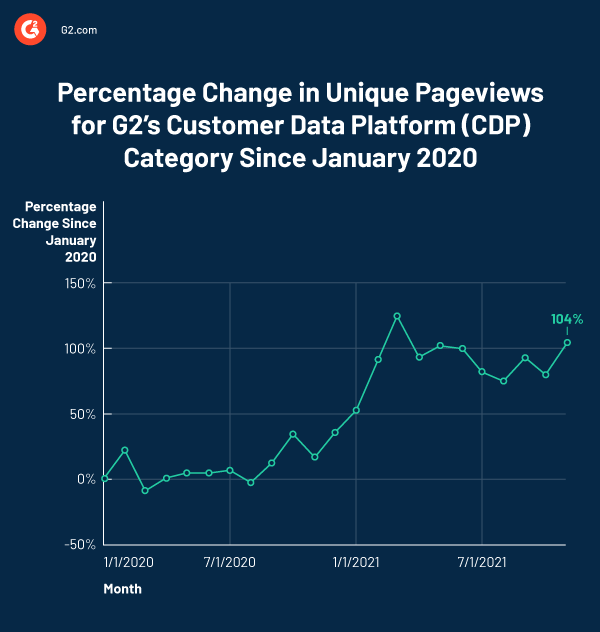

Like the CDP category on G2, we expect to see growth in the retail media advertising category in both page traffic and the number of user reviews in the coming year.
Brands will demand more flexible advertising options
Brands want more flexible advertising options to move closer to customers online in a brand-safe way. This would result in retail media networks evolving from launching traditional media businesses to offering more self-service tools for media planning and buying. Additionally, more and more brands are utilizing retail media advertising platforms because it is now much easier to measure and attribute the impact of ads on retail media networks than ever before.

Brands will increasingly adopt retail media advertising platforms to assist in promoting products closer to the point of sale in a more personalized, engaging way.